

By Julian Fyfe, Sustainability Lead, AWA Environmental
When was the last time you asked yourself, ‘Is there enough water?’ Perhaps it was while planning a remote camping trip, a new irrigation scheme, or a construction job with limited nearby sources. Otherwise, with our small population and freshwater sources replenished by reliable rainfall, it’s a concern that is not often raised in Aotearoa New Zealand.
While water security may not be a burning issue, there are nonetheless limits to the amount of fresh water that can economically and sustainably be drawn from the environment. Whether they are related to limited source yields, water quality issues, maintaining environmental flows, climate extremes or infrastructure capacity, every region in the country has some form of constraint on supply that, if exceeded, would lead to water scarcity.
As population and economic growth cause water demands to rise, we will inevitably start to press up against these boundaries. And factors like rising temperature and evaporation, shifting rainfall patterns and severe weather events (both drought and floods) associated with climate change, together with broad-scale pollution, further constrain the availability of fresh water.
At the end of the day, it simply costs more to do more. Expanding water supplies is never cheap, and as our options for new sources contract, the costs only increase. A catchphrase that has been circulating in the water sector of late is, ‘The cheapest water you’ll ever get is the water you already have.’ In other words, it is a wiser investment to use water as efficiently and effectively as possible than it is to collect, treat, and distribute more of it to meet growing demand.
When we talk about water servicing, we tend to refer to how many units of water are needed to supply a house, business or development; and if required, we move to augment the supply. To provide cost-effective and sustainable water servicing, we need to invert this thinking: How many houses, businesses or developments can we service with the volume of water that we have available to us? If the answer is ‘not enough’, then the next question needs to be: How can we use the water we do have more productively so that it goes further? Rather than simply increasing water take to support growth, we should seek to derive the greatest economic benefit out of the water we already have access to first.
Age-old phrases like, ‘using water wisely’ and ‘doing more with less’ come to mind; but to emphasise the economic credentials of this concept, it needs to be expressed in a way that will resonate with water planning decision-makers. I suggest the term ‘water productivity’.
Productivity is a widely used economic term referring to the efficiency of converting capital and labour into outputs within an economy. When applied to consumption of a natural resource as a measure of the effectiveness and efficiency of the use of that resource, it is also an indicator of environmental sustainability. Resource productivity is both the action and the metric of the sustainable use of natural resources. Importantly, resource productivity ‘is as much about maximising profit at the firm level as it is about limiting negative environmental impacts’.1
‘Water productivity’ is not a new term, and is typically associated with the agricultural sector. In this context, it refers to ‘the ratio of agricultural output to the amount of water consumed’2; however, water is also a fundamental input to urban economies, and there is every reason to apply the concept to this context. Data centres are a case in point; a rapidly emerging water-intensive industry that is causing water resource managers to re-examine water allocations and urban water planners to have to rethink their short- and long-term supply-demand balance.3
In recent years, we have started to see water scarcity become more commonplace in Aotearoa New Zealand. The obvious example is the 2020 Auckland drought, when dam storage dropped to 42.5 per cent, necessitating 17 months of water restrictions including a 217-day ban on outdoor water use.
StatsNZ reports that medium-term droughts that impact agricultural production increased in frequency across much of Aotearoa between 1972 and 2022.4 In 2023–24, 35 water suppliers had water restrictions in force for an average of 137 days of the year due to supply-demand imbalances.5 This was up from 113 days across 25 suppliers in 2022–23 and 18 days across 15 suppliers in 2021–22.6 Importantly, scarcity is not solely a function of growth, hydrology and infrastructure; it can also be a result of environmental pollution. Nitrate contamination of groundwater resources in the Canterbury region is putting private and public water supplies at risk of becoming unsafe for drinking.
To compound the scarcity issue, we are facing fewer options for developing new sources, and the cost of developing new sources, such as large-scale dams and seawater desalination, approach an order of magnitude greater than conventional sources. Thus, we have a convergence of multiple drivers for water productivity: protecting and conserving the resource, increasing resilience, reducing infrastructure costs, and improving the affordability of water servicing.
Water productivity is measured as units of economic output per unit volume of water consumed – the inverse of how water consumption and efficiency are typically expressed. The economic units can be quantities of households, businesses, products or services. The metric can be benchmarked across sectors, industries, water suppliers and regions.
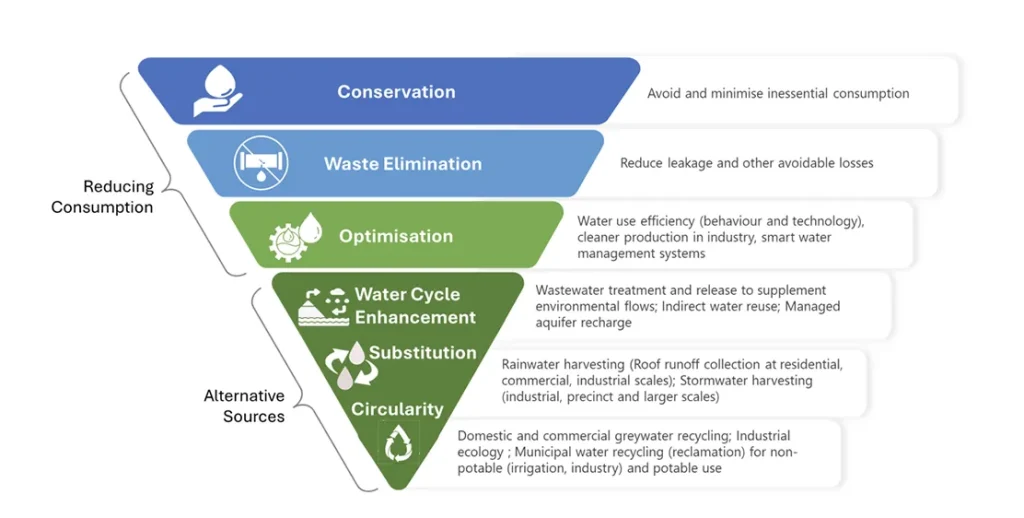
The pursuit of water productivity can be framed by a hierarchy of strategies as depicted in Figure 1. Conservation, waste elimination and optimisation are analogous to upper tiers of the classic waste hierarchy in that they are the most sustainable and cost-effective means of increasing water productivity. The relative sustainability benefits of the substitution, circularity and water cycle enhancement strategies are less clear-cut and need to be assessed on a case-by-case basis.
There are plenty of examples internationally of campaigns to improve water productivity, albeit with the broader purpose of water security. Water utilities across Australia supported their communities to improve water efficiency in response to drought and scarcity in the 2000s. Now, they are embracing alternative water supplies to bolster resilience. California is moving towards a far-reaching water efficiency regulatory regime in response to forecast supply shortfalls. The water sector in the United Kingdom, meanwhile, has a particularly keen focus on water loss elimination.
In Aotearoa, metering and pricing will be a crucial component to the water productivity drive. Currently, less than half of water suppliers meter more than 50 per cent of their residential customer base, leaving significant gaps in both supplier and customer understanding of water demand. We meter every other utility, including power, call time, data, road miles, and so on. But not water. The case for metering and volumetric charging has recently been laid out by the New Zealand Infrastructure Commission.7
It is important to point out here that water productivity measures should not be construed as reductions to levels of service – it’s about improving our infrastructure, hardware, systems and processes to consume less without compromising performance or experience.
In Aotearoa, we have time on our side so that this can be a gradual turning of the dial towards what could be a radical change in the long term. The first, and perhaps most important, step, however, is reframing the value of water so that we all see it not simply as a resource, but as taonga.
Back in 2011, McKinsey & Company identified reducing municipal water leakage and improving irrigation techniques as two of the top 15 global resource productivity opportunities, offering a $282-million total resource benefit and an 18–21 per cent reduction in water resource demand.8
There has not been a follow-up analysis of progress towards this target, but it is clear that embracing water productivity as a KPI for businesses, a sustainability measure for water suppliers and a policy lens for central government is the right move for Aotearoa economically, and environmentally. It is also crucial to giving effect to Te Mana O Te Wai. 
About the author
Julian Fyfe is a sustainability and engineering professional with more than 20 years of experience in the water sector. Drawing on experience across academia, consulting, and water servicing and infrastructure delivery, he is committed to the advancement of sustainable outcomes for communities and the environment.
End notes
- www.auckland.ac.nz/assets/arts/our-research/research-institutes-centres-groups/ppi/policy-briefings/competitiveness-sustainability-and-the-environment.pdf
- www.unescwa.org/sd-glossary/water-productivity-productivity-water-wp
- www.eesi.org/articles/view/data-centers-and-water-consumption; www.lincolninst.edu/publications/land-lines-magazine/articles/land-water-impacts-data-centers/; https://theconversation.com/data-centers-consume-massive-amounts-of-water-companies-rarely-tell-the-public-exactly-how-much-262901; www.cloudcomputing-news.net/news/data-centre-water-consumption-crisis/
- www.stats.govt.nz/indicators/drought
- www.taumataarowai.govt.nz/about-us/reports-and-publications/water-services-insights-and-performance
- www.waternz.org.nz/nationalperformancereview
- https://tewaihanga.govt.nz/our-work/research-insights/valuing-water-sustainable-water-services-and-the-role-of-volumetric-charging
- www.mckinsey.com/~/media/mckinsey/business%20functions/sustainability/our%20insights/resource%20revolution/mgi_resource_revolution_full_report.pdf.