
By Craig McIlroy, General Manager Healthy Waters and Flood Resilience, Auckland Council
We can’t stop the rain, but we can use this once-in-a-lifetime opportunity to get our approach to stormwater right.
Now is the time for a new future for stormwater. It seems that a different part of our country is hit by severe weather every month. Back in early 2023, it was Auckland’s turn. The rainfall was off the scale and about 60 per cent of the region was hit, which was why we had such widespread devastation.
We’ve got to embrace a new way to manage stormwater – building larger pipes simply won’t work because we know there are even bigger storms coming in the future. Based on global experience, severe weather can strike anywhere at any time. There was even a recent storm in Dubai, which was unprecedented.
We need to plan for a worst-case scenario and then work backwards from that to see what is affordable, because none of us know where or when it’s going to hit.
Climate change is a given, and our community’s awareness of flood risk is at an all-time high. But, most importantly, the current three waters reforms gives us a once-in-a-lifetime opportunity to get our response right to these unprecedented storms.
A different model so stormwater isn’t the poor cousin
The new water entities are now all set up, but they’ve got major wastewater and water challenges – such as Wellington’s recent issues with sewage flowing into the south coast.
My greatest concern is that stormwater will be the poor cousin if it’s part of a three waters entity. There’s no way stormwater will get the same attention as water and wastewater from day one. Even the Water Services Authority – Taumata Arowai, the water services regulator, has stormwater as its third priority.
I don’t want stormwater to be the poor cousin because providing a resilient stormwater network is something our communities are demanding, especially those who have suffered in recent storms. I think stormwater would be better managed using a different model – where city/district councils and regional councils come together as one entity in an area to manage stormwater.
That’s the model being used in Tāmaki Makaurau through Auckland Council’s Healthy Waters and Flood Resilience department. Under the Local Water Done Well reforms, there is now a once-in-a-lifetime opportunity to develop regional stormwater entities based on regional council boundaries. This might be made easier by the government’s current proposal to merge smaller councils into larger unitary authorities.
At the moment, city/district councils manage urban stormwater and regional councils manage rural stormwater. Water doesn’t know whether it’s urban or rural, so those organisations must work as one stormwater entity to ensure the best solution for our communities.
You wouldn’t drive a car without national standards
One of the main problems we’ve got at the moment is that there are no stormwater standards across Aotearoa New Zealand – every area just applies its own standards.
We need to produce a set of national standards that everyone signs up to – both technical standards and ones focused on our customers. A simple analogy is that we wouldn’t hop in our cars unless everyone agreed to drive on the same side of the road.
The Water Services Authority – Taumata Arowai (from a technical perspective) and the Commerce Commission (from a financial perspective) must get their heads around what needs to be done.
Councils are currently producing risk management plans without any national standards to base them on. The risk threshold settings need to be nationally consistent to get to a fair and equitable outcome across the country.
We need to work with water’s natural flow
For solutions to extreme weather events, we need to go back to pre-European times and think about how nature designed land to work before we all came along. When cities are developed, natural streams are often piped underground to create more land for building – but in doing so, we undermine the natural ways stormwater is managed across the landscape.
Now the pipes can’t cope, so we need to work with water’s natural flow.
The problem with pipes and culverts is that they’re prone to being blocked by rubbish and debris. And when the pipes fail, the water has to go somewhere else.
The basis of our new future is nature-based solutions like what we call ‘blue-green networks’. They’re at the core of our intergenerational Making Space for Water programme, which is supported by nearly $2 billion in storm recovery funding from central government and Auckland Council.
A blue-green network is where instead of directing water through a pipe, you make space in the urban landscape for the stream to flow through a green area. The idea is that the green bit that sits alongside the stream becomes blue in a very extreme event.
Parks are a wonderful opportunity for proactive stormwater management; 99 per cent of the time, they can be green parkland. But when you get an enormous downpour, if you can somehow divert water to that parkland – quite often, parks are in low-lying areas – they can become temporary storage areas.
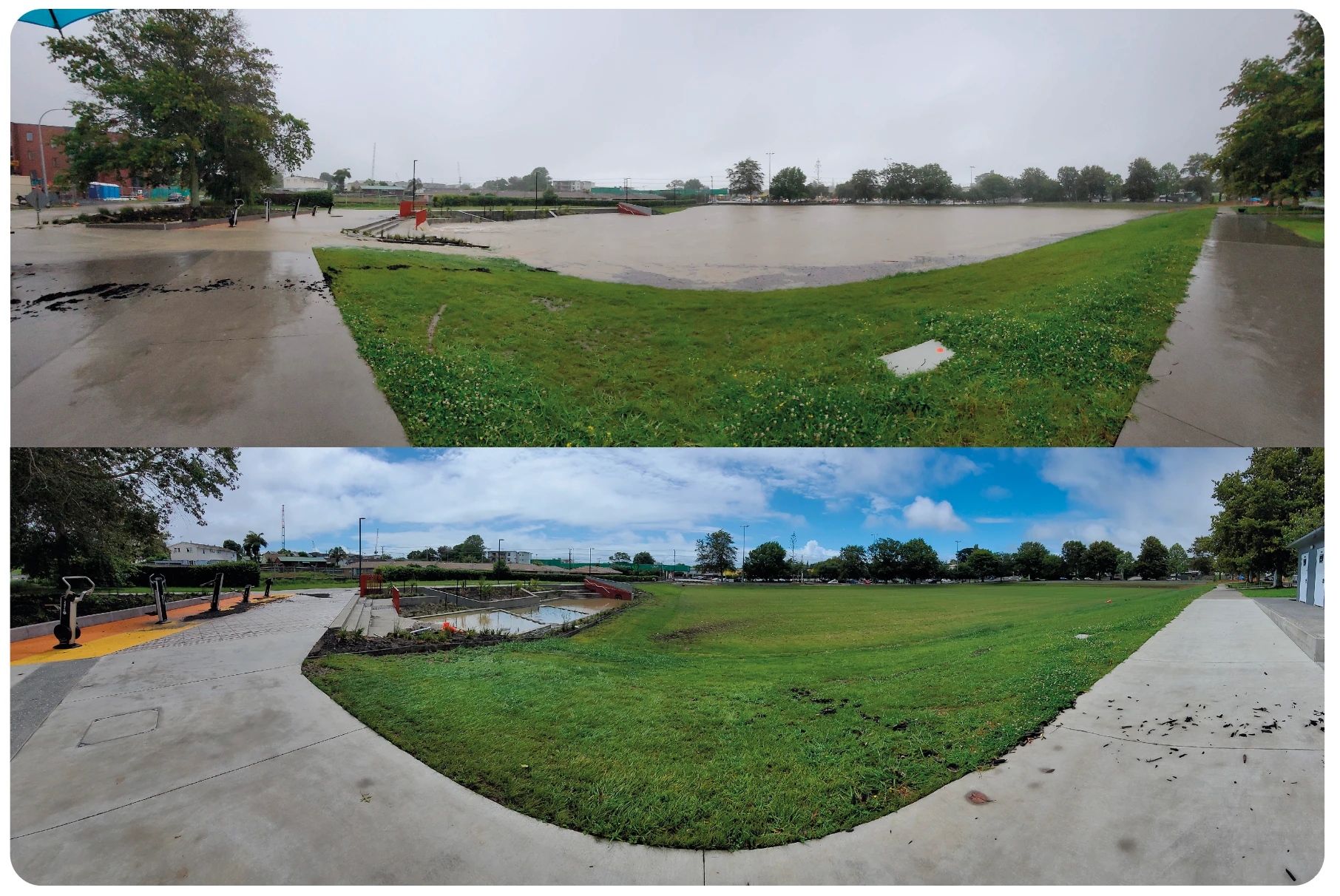
A good example is Greenslade Reserve in Northcote, on Auckland’s North Shore, where there’s a playing field that’s designed to flood in an extreme event. During the January 2023 storm, it did exactly that, but within 24 hours it was green again.
That’s the type of approach we need, and it’s why, in my opinion, stormwater should be a core council business. To manage stormwater, you need to zone the land correctly, and you also need to co-design with transport and parks.
Through our future land use planning, we need to apply the right zoning to create new spaces where water can go – keeping water away from both residential and commercial properties as much as possible.
But flood risk can’t be reduced by council alone – it requires all of us working together. We need collaboration between local and central government, partnerships with iwi and community organisations, and support from banks and insurers to keep up momentum and achieve long-lasting results.
Everyone has a role to play. While we can’t stop the rain, together we can build resilience and be ready for its impacts. 
Find out more about Auckland’s Making Space for Water programme and sign up for the bimonthly newsletter at www.aucklandcouncil.govt.nz/msfw.
First blue-green networks since 2023 storms near completion
The first blue-green network projects to move into construction following the devastating 2023 Auckland Anniversary floods are on track for completion in the next few months.
The Harania Creek and Te Ararata Stream projects in Māngere, with a combined budget of $53 million, will significantly reduce flood risk for around 376 properties, including 56 assessed as facing an intolerable risk to life.
By focusing on flood mitigation rather than relying on property buy-outs, the projects provide a cost-effective and community-focused solution with long-term benefits.
Construction began in April 2025, with Te Ararata due to be finished in August and Harania following in October.
In May, the largest crane in Aotearoa New Zealand was assembled on the Harania site to lift a new section of pipe into place – a key milestone in the project. Due to its scale, the crane itself had to be assembled onsite using another crane.
A recent independent Audit New Zealand review of the Māngere projects found council showed strong financial management, effective collaboration and disciplined delivery. It highlighted early contractor involvement; independent cost benchmarking; and robust governance, contract management and risk oversight as key strengths.
Pictured: Greenslade Reserve’s playing field is designed to flood in an extreme event. Images show the field during and after the 2023 Auckland Anniversary storm