
By Janie Smith, Communications Advisor, Watercare Services Limited
While the Watercare Central Interceptor project team is gearing up for the tunnel to become fully operational, the Māngere Wastewater Treatment Plant team has been readying the plant for the increased wastewater flows.
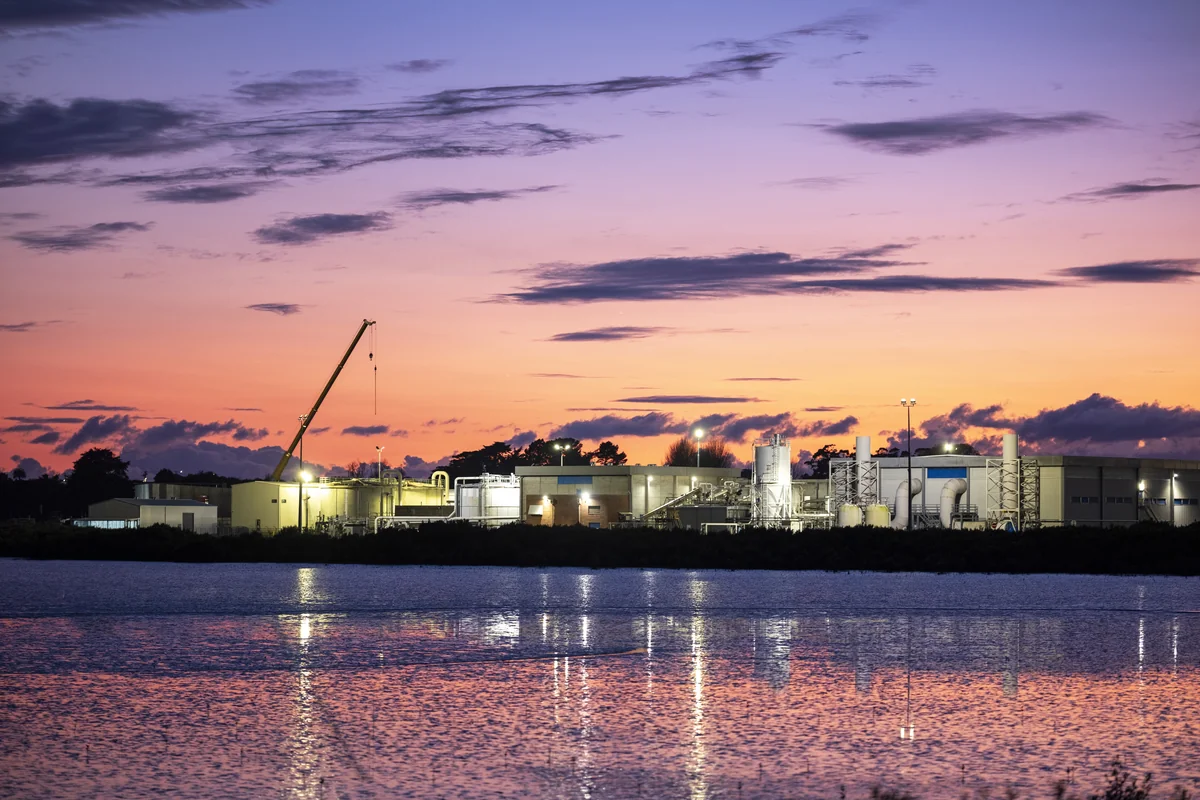
Māngere is Auckland’s largest wastewater treatment plant and one of the most advanced in the world. It handles about three quarters of the region’s wastewater and liquid trade waste, and it has projects underway to prepare for the additional wastewater flows from the Central Interceptor.
Watercare is investing in long-term infrastructure, renewing existing assets and planning ahead to support a growing Auckland for generations to come, while protecting the health of water, the environment and the communities connected to it.
Part of this involves exploring new technology to improve how it works through smarter delivery, and better systems to ensure it is getting the most out of its infrastructure. Enhancements to the Māngere Wastewater Treatment Plant are a prime example of that.
New technology called inDENSE™ was trialled to see if it could increase the plant’s ability to treat wastewater without building more infrastructure. The pilot programme was so successful that permanent inDENSE units are going to be installed on three reactor-clarifiers, with the goal of increasing their treatment capacity by around 20 per cent.
As part of the wastewater treatment process, wastewater flows into the reactor-clarifiers. In the reactors, microorganisms (activated sludge bacteria) remove contaminants from the wastewater. In the clarifiers, the activated sludge settles to the bottom of the tank, while cleaned wastewater rises to the surface. The treated wastewater is conveyed through filtration and UV disinfection prior to discharge to the environment. The faster the activated sludge settles in the clarifier, the greater the volume of wastewater that can be treated by the reactor-clarifiers.
The concentration of activated sludge in the reactor increases over time due to biomass growth as microorganisms consume contaminants in the wastewater. To maintain stable operating conditions and appropriate solids levels, a portion of this sludge must be removed from the system.
InDENSE improves process performance by retaining fast-settling activated sludge while removing slower-settling material. This is achieved using a hydro cyclone, which spins the sludge to separate heavier, fast-settling particles from lighter, slower-settling ones.
Keeping the plant’s footprint the same, rather than building more reactor-clarifiers, also reduces carbon emissions.
Upgrades are also planned for the system that handles solids removed during the initial screening of raw wastewater. The inlet drum screens filter out anything larger than three millimetres, and these materials, known as screenings, need to have water removed from them before they go to landfill.
The plant currently has two drainage screws, which are large screws on an incline, where solids are conveyed upwards as the screws rotate, allowing water to drain back downwards.
The design phase has been completed for a project to replace the two existing drainage screws with three new higher-capacity units. This will be a complex construction project undertaken within a live treatment plant environment, and is a critical step in enabling the plant to efficiently manage increased flows from the Central Interceptor.
The plant’s ultraviolet disinfection system is also being upgraded with more efficient equipment to increase treatment capacity and overall performance.
The wastewater treatment process at Māngere
The plant treats wastewater in three stages, with a total treatment time of approximately 12 hours.
The first stage involves screening raw wastewater to remove material larger than three millimetres, which is dewatered and sent to landfill. The screened effluent then enters sedimentation tanks, where sand and grit are removed, and heavier solids settle to the bottom and are separated from the liquid.
In the second stage, aeration and pumping in the reactor-clarifiers creates conditions that support the growth of microorganisms, which remove contaminants. These microorganisms consume organic carbon, and reduce levels of phosphorus and nitrogen in the wastewater. In the aerobic zones, ammonia and organic nitrogen are converted to nitrates, while in the anoxic (oxygen-free) zones, these nitrates are converted to harmless nitrogen gas. This process is known as biological nutrient removal.
In the final stage, the treated wastewater is filtered and disinfected using UV light, achieving up to a 10,000-fold reduction in harmful pathogens without the use of chemicals.
The treatment process includes stringent quality testing at every step before the final effluent is safely discharged into Manukau Harbour during outgoing tides. Solids from the process are thickened, stabilised through digestion and dewatered to make them safe for disposal. Following dewatering, lime is added to further stabilise the biosolids by raising the pH, helping to reduce pathogens, control odour and improve handling.
Treated biosolids are transported to Te Motu a Hiaroa (Puketutu Island) to support rehabilitation of the former quarry.
During the solids treatment process, methane-rich biogas is produced and used in engines to generate electricity for the plant. Biogas can provide up to 50 per cent of the plant’s energy needs, significantly reducing operating costs.