
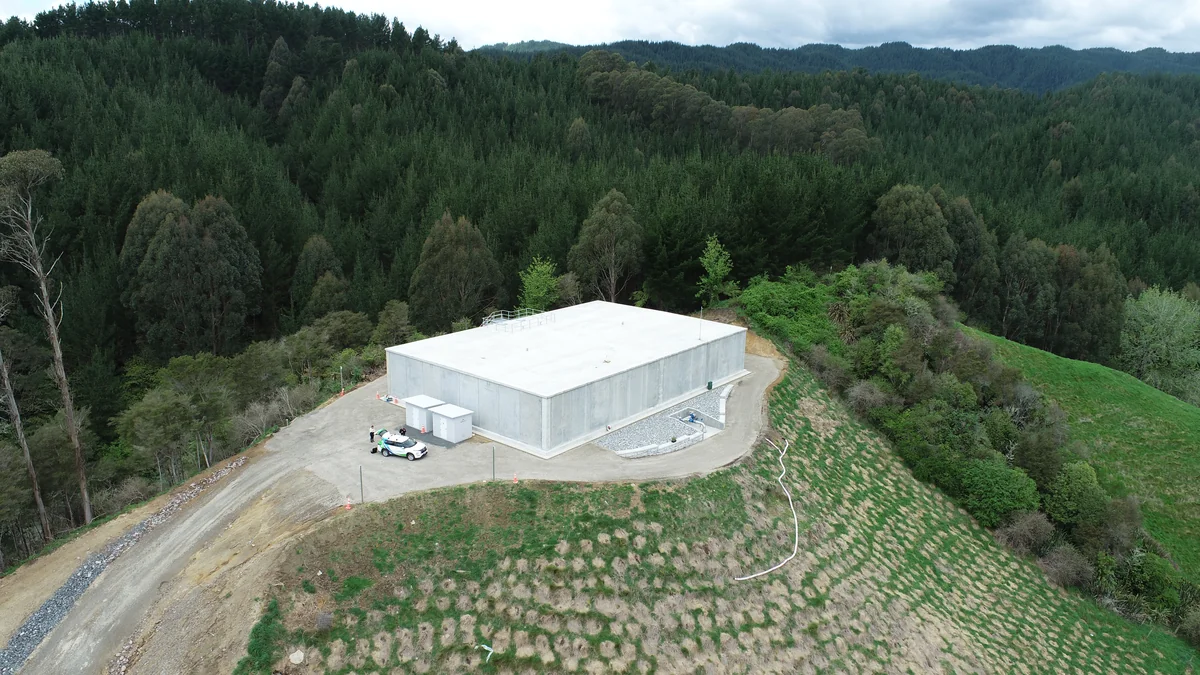
The new Ōtūmahi Reservoir in Te Teko is adding 4.2 million litres of treated drinking water to the district’s supply, boosting the network’s reliability, and providing greater confidence for households and businesses.
On the Eastern Plains of the Whakatāne District, water resilience has always been about distance and timing – how fast treated water can reach homes, and how long that supply can last when the weather turns dry. For Edgecumbe and Te Teko, those questions have shaped planning for decades. Now, the new Ōtūmahi Reservoir, above Ōtūmahi Lane in Te Teko, is changing the game, adding 4.2 million litres of treated drinking water to the district’s supply, and giving the network a serious boost in strength and reliability.
This isn’t just a big concrete tank – it’s a lifeline for households, schools, marae, trade premises and local businesses. It can hold enough water to fill nearly two Olympic-sized swimming pools or supply up to 20,000 people for two summer days. While it won’t completely remove the need for water restrictions during long dry spells, it provides a crucial buffer and helps to keep pressure steady across the network – something that’s been a headache for years.
Why this was needed
Before Ōtūmahi, the Eastern Plains network had limited storage, and pressure could drop when demand spiked. Extended dry periods meant bore water levels could fall, leaving little margin for firefighting and essential services. Whakatāne District Council set out to fix that with a solution that added serious storage, stabilised pressure and futureproofed the network for growth.
For rural communities like Edgecumbe and Te Teko, water isn’t just about convenience; it’s about safety and livelihoods. Schools, marae and local businesses need reliable supply. Firefighting capacity is critical. Without enough stored water, emergency response can be compromised. The reservoir was designed to change that.
How it works
Water comes from two bores at the Ōtūmahi Water Treatment Plant, one commissioned in 2017 and the second added in 2024. After treatment, pumps lift the water to the elevated reservoir through a new rising main. From there, a delivery pipe connects the reservoir to the existing network on Paul Road, helping to maintain consistent pressure across the supply area.
The reservoir itself is a reinforced concrete structure with two compartments, each holding about 2100 cubic metres. That means that one side can be taken offline for maintenance without cutting supply, a clever design that adds flexibility and resilience. The site, once a paddock, is now landscaped and planted with native vegetation to stabilise the land, and support local ecosystems and biodiversity.
Built by locals, for locals
The build took seven months and finished without delays, a big achievement for a project of this scale. Key features include 1.9 kilometres of welded high-density polyethylene piping, stainless steel manifolds and fittings, and solid retaining walls and drainage systems. Every welded joint was pressure-tested before commissioning. Reinforced concrete panels were made locally, supporting regional businesses and cutting transport costs. The teamwork between contractors was outstanding, with clear communication and sequencing that kept everything on track.
Jim Finlay, Manager Assets & Capital Delivery – Three Waters, says local partnerships made all the difference. ‘Twelve contracting companies contributed to the project – nine local and three specialist firms – with exceptional coordination and no delays. Using locally made panels and regional supply chains gave us certainty and supported the local economy.’
Smart, strong and ready for anything
Ōtūmahi Reservoir isn’t just big, it’s smart. The structure is built to withstand earthquakes and extreme weather incidents. Remote-operated valves and monitoring technology provide real-time information on water quality, including pH, turbidity and chlorine levels. Monitoring gear is installed at the plant and downstream of the reservoir, feeding into Whakatāne District Council’s real-time data platform.
Precast concrete equipment sheds, each weighing more than 10 tonnes, protect sensitive monitoring and control assets. These sheds are built tough, so critical infrastructure stays safe even in wild conditions. The remote monitoring technology means that operators can respond fast to any changes in water quality or pressure, reducing risk and improving reliability.
And it’s not just about pipes and pumps – native planting around the site adds resilience, stabilising the land and supporting local ecosystems. It’s a small touch that shows engineering and environmental care can go hand in hand.
What’s changed already
Since commissioning these works, the reservoir has delivered exactly what was promised. Pressure across the network is more consistent, and the extra storage has already provided a buffer during high-demand periods.
‘This reservoir isn’t just about storage; it’s about resilience. It gives us flexibility and improves firefighting capacity, giving emergency services confidence that the supply will be there when it counts. The remote data and operating systems mean the network can be managed proactively, which is a big step forward for our staff and reduces travel time,’ says Finlay.
Looking ahead
Ōtūmahi Reservoir is part of a bigger picture. Pipe sizing and network connections have been designed for future growth, so the system can expand across the Plains and Coastlands areas. This isn’t just a fix for today; it’s an investment in tomorrow.
Other councils can take a few lessons from this project: set resilience goals early, design for flexibility and use technology to keep assets performing at their best. Real-time data isn’t a nice-to-have anymore; it’s essential. And don’t underestimate the power of local partnerships. They bring agility, accountability and a shared commitment to getting the job done.
Why it matters
Water infrastructure might not grab headlines, but it shapes everyday life. For Edgecumbe and Te Teko, the Ōtūmahi Reservoir is more than concrete and pipes; it’s peace of mind. It means families can turn on the tap without worry, kura can keep running and firefighters can respond knowing the supply is there. In a world of climate uncertainty and growing demand, that kind of resilience is priceless. 
Images features the Ōtūmahi Reservoir, courtesy of Whakatāne District Council.