
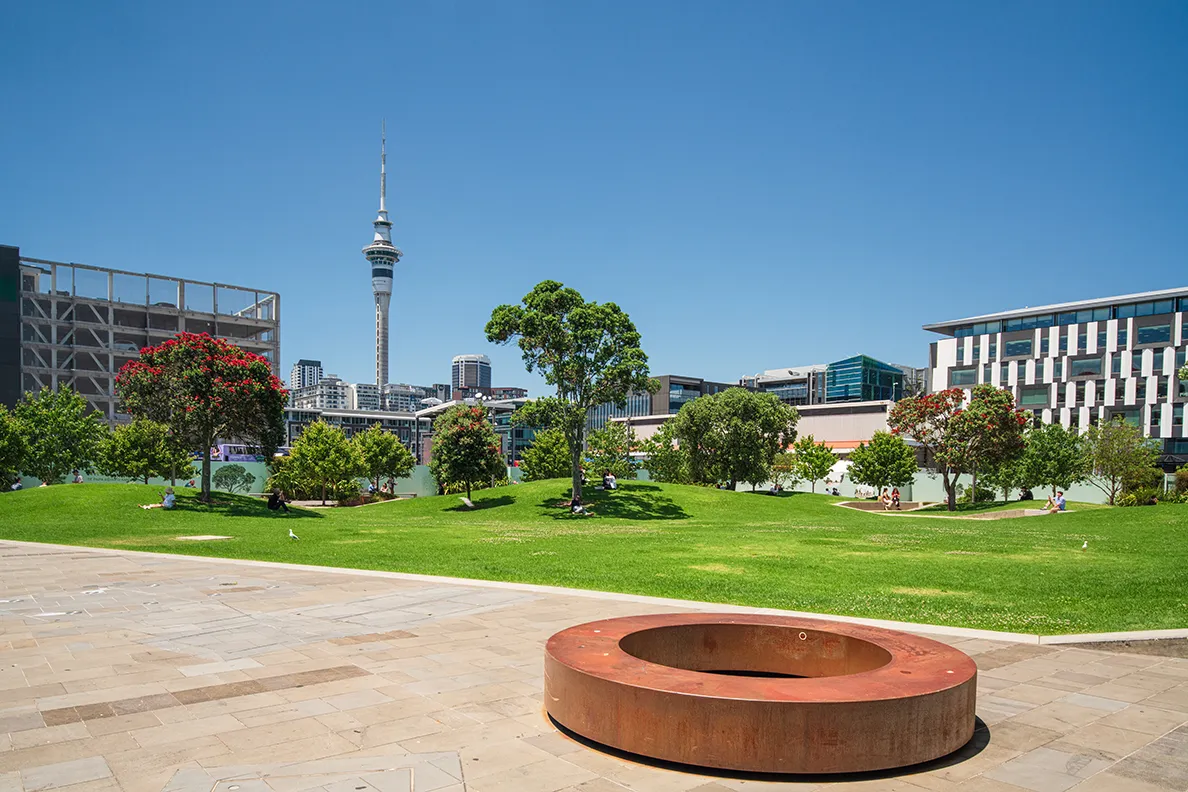
Auckland Council is among a growing number of local authorities turning to blue-green infrastructure and sponge cities to help manage increasingly common climate change–prompted events such as floods, on one hand, and droughts, on the other.
Blue-green infrastructure integrates natural water management with green spaces to enhance urban resilience and biodiversity, providing essential ecosystem services while improving the quality of life for city residents. Sponge cities, designed to absorb and purify rainwater, mimic the natural water cycle and significantly reduce flood risks, showcasing innovative approaches to sustainable urban planning.
Auckland’s approach to the regional blue-green network is focused on enhancing the region’s resilience to climate change while improving biodiversity and community outcomes, as it also prepares for a population increase of 600,000 over the next three decades and considers a range of interrelated pressures on the natural environment.
One of Auckland Council’s first steps – which emerged from Te Tāruke-ā-Tāwhiri: Auckland’s Climate Plan 2019, and Te Rautaki Wai a Tāmaki Makaurau Auckland Water Strategy 2022–2050 – is to create resources to support the development of a regional blue-green network. The aim is to enable a more strategic and coordinated approach that enhances, expands and maintains Auckland’s regional blue-green network for the multiple outcomes sought.
‘We’re working across the organisation to develop a set of resources, particularly a regional map of what the regional blue-green network is and should look like for Auckland,’ says Sam Anwar, Auckland Council Principal Analyst, Natural Environment Strategy.
The mapping effort aims to improve biodiversity, enhance social connections and bolster resilience against climate‑related challenges.
Recent extreme weather events, including the devastating floods of early 2023, underscore the urgency of Auckland’s blue-green network, as well as flood-resilience programmes and projects.
A key Auckland Council programme that has emerged following the devastating floods is Making Space for Water. It aims to reduce flood risk and includes the creation of greenways and environmental corridors that allow floodwaters to flow safely through urban areas.
This programme includes a dedicated team working to implement blue-green flood-resilience projects at pace. It’s a forward-looking approach and includes a proposed $760-million, 30-year plan seeking to integrate blue-green infrastructure into urban planning, creating a sustainable environment that can adapt to the challenges posed by flooding and urban heat.
‘We are massively scaling up our efforts in response to the 2023 floods,’ says Sara Zwart, Auckland Council Principal, Project Delivery.
The concept of sponge cities is central to Auckland’s blue-green network approach, which envisions urban areas that can absorb and manage excess water.
‘It’s about how we create greenways, environmental corridors and community spaces that literally make space for water,’ says Zwart, highlighting the need for a multifaceted approach to urban resilience.
‘The infrastructure being developed will be designed to absorb water to a point, but it is equally important to create space for floodwaters during major events,’ she says.
Technology is key to supporting any council’s blue-green strategy. Engineers designing and simulating stormwater systems need data from terrain, rainfall, land use and infrastructure to model how water behaves under different conditions. This includes evaluating the impact of green infrastructure like permeable pavements and bioswales – key elements in sponge city design.
‘Software is needed to optimise wastewater and stormwater management, and build resilience against climate challenges. On the rise is the use of digital twins to simulate and visualise water behaviour,’ says Cecilia Correia, Water Industry Strategist, Bentley Systems.
‘Engineers used to struggle to get a complete and accurate picture of a situation, but now they can use digital twins to combine geospatial context with data and insights from engineering models, as well as artificial intelligence (AI) and real-time sensor data,’ says Correia.
This enables cities to anticipate flood risks, optimise wastewater treatment and better manage stormwater, incorporating new ways of thinking with blue-green and nature-based solutions.
Technology also supports predictive modelling, which plays a role in the design and implementation of green sponge city infrastructure.
‘By using software tools, we can model the land, vegetation and climate interactions that underpin sponge city, nature-based approaches and compare them with traditional grey infrastructure approaches. Of course, a comprehensive understanding of both is required to assess the impact of rainfall and stormwater on urban drainage systems,’ says Pat McLarin, Segment Director, Seequent, the Bentley Systems Subsurface Company.
A challenge is understanding the connectivity and character of groundwater systems, and their local relationships with surface water networks. Better understanding of groundwater systems and opportunities for managed aquifer recharge as part of a sponge city approach could make cities more climate-resilient.
‘This is becoming even more imperative as flood magnitude is increasing, and urban areas grow in size and density,’ says McLarin.
Auckland is a natural candidate for further developing its blue-green infrastructure, given that Arup’s Global Sponge Cities Snapshot identified it as the city with the spongiest urban centre. The snapshot is based on Arup’s AI and land use analysis tool, Terrain. It looked at the urban centres of 10 global cities: Auckland, London, Montreal, Mumbai, Nairobi, New York, Shanghai, Singapore, Sydney and Toronto. The snapshot’s results calculate the amount of green and blue area in each city, factoring in soil types, vegetation and rainfall run-off.
‘Auckland was identified as having the spongiest urban centre; however, even the spongiest cities can enhance their absorbency and work with nature to improve their resilience to flooding,’ says Matthew Baikie, Arup’s Climate and Sustainability Leader, New Zealand.
‘Our way of delivering sponge cities is grounded in integration and systems thinking. We take a catchment‑based approach to reduce and slow stream and river flows, and contain floodwaters; apply regenerative design to restore and enhance natural systems; and embed adaptability to ensure flexibility in the face of future uncertainty,’ he says.
While Auckland is relatively advanced in its thinking around its blue-green infrastructure, a number of other cities are also exploring this area. It’s understood that Copenhagen, Philadelphia and Shanghai are moving from pilot projects to full-scale sponge city strategies.
‘Many cities are considering hybrid infrastructure models, combining traditional grey infrastructure with green and blue infrastructure, to enhance system performance and better protect communities,’ says Baikie.
‘Urban planning policies are increasingly recognising the benefits of working with nature, with cities embedding sponge city principles into zoning laws, building codes and climate adaptation plans – including Berlin, Jakarta and New York City,’ he says.
There are hurdles to overcome to scale up implementation, including funding challenges; although, there are opportunities to address this though integrated financing.
‘Space in cities can present challenges, especially in dense urban environments that are seeking to retrofit green and blue infrastructure,’ says Baikie. ‘This provides an opportunity to creatively repurpose existing land uses, such as floodable parks, rain gardens and permeable pavements.’