
By Pitolau Lusia Sefo-Leau, CEO, Pacific Water and Wastewater Associaiton
Across the Pacific, a new generation of water professionals is stepping forward to tackle some of the region’s most urgent infrastructure and climate challenges.
When Katrina Mariner was appointed Executive Director of the American Samoa Power Authority (ASPA) earlier this year, it marked a significant moment for Pacific utilities leadership. Her appointment drew attention across the region not only because she became one of the few women to lead a Pacific utility authority, but because her professional journey reflects a growing regional effort to develop future water leaders from within the Pacific itself.
Mariner, who brings more than 15 years of experience across water and utilities engineering in Samoa and American Samoa, previously held technical and leadership roles within ASPA, the Samoa Water Authority, and Samoa’s Ministry of Natural Resources and Environment. She is also a former participant in the 2019 Pacific Water and Wastewater Association (PWWA) Young Water Professionals (YWP) programme, an initiative designed to support and develop emerging leaders within the Pacific water sector. Her appointment reflects the kind of leadership pathway the programme aims to foster across the region.
Her rise to executive leadership also highlights a gradual shift taking place within Pacific utilities – a sector historically dominated by men, despite the growing number of highly qualified Pacific women working across engineering, environmental science, infrastructure and water resource management.
Around the Pacific, utilities are operating under growing pressure. Climate change, aging infrastructure, population growth, workforce shortages and increasingly complex operational demands are placing strain on already-stretched systems. At the same time, many utilities are confronting a major succession challenge; preparing the next generation of leaders capable of managing water systems in one of the world’s most climate-vulnerable regions.
Within this landscape, the YWP programme has become one of the region’s most respected capacity-building initiatives. Led by the PWWA and supported by the Australian Water Partnership, the programme focuses on developing early-career professionals through technical training, mentorship, leadership development and regional networking opportunities.
The programme’s investment in leadership development was evident during Ozwater 2025 in Adelaide, Australia, where several Pacific YWPs attended one of the world’s leading international water conferences as part of their professional development and regional exposure.
For many participants, the experience shaped how they viewed both their professional futures and the role Pacific voices can play within global water conversations.
For Vanuatu’s Aetrian Robert, attending the conference was both personally and professionally transformative.
‘Attending Ozwater was an incredible experience for me personally and professionally,’ she reflects. ‘Representing Vanuatu on that stage felt both overwhelming and inspiring.’
Exposure to global conversations around water resilience and infrastructure reinforced the importance of developing solutions grounded in Pacific realities.
‘For my work in Vanuatu, this reinforced the need to evaluate infrastructure through our own local lens,’ she says. ‘Adopting solutions without understanding our context won’t lead to sustainable development.’
For other participants, the experience expanded how they viewed innovation and long-term planning within Pacific utilities. David Bai, of the Palau Public Utilities Corporation and Pacific YWP of the Year 2023, reflected on the importance of balancing emerging technologies with traditional knowledge systems as Pacific communities face increasing climate threats.
‘Building climate resilience requires a strong foundation in traditional knowledge, reinforced by science and technology,’ he says. ‘We can’t rely on one without the other.’
Meanwhile, Samoa Water Authority Wastewater Engineer Faumuina Tua Vaai says the programme challenged him to think differently about leadership and the future of Pacific water systems.
‘This experience wasn’t just about technical learning,’ he says. ‘It challenged how I think about leadership, sustainability, and the future of water systems in Samoa and across the Pacific.’
Experiences like Ozwater continue to play an important role in building technical knowledge, confidence and regional solidarity among young professionals facing many of the same challenges across geographically distant island nations.
The annual Pacific Young Water Professional of the Year award, presented during the PWWA Conference and Expo, has also become an important part of the regional water calendar, recognising emerging leadership while reinforcing the sector’s commitment to developing future Pacific leaders.
Embedded within the conference programme itself, the YWPs initiative has evolved into a visible platform for mentorship, regional collaboration, technical exchange and leadership development, connecting emerging professionals directly with utility leaders, policymakers and regional partners.
For many participants, the programme offers a rare opportunity to step beyond their local contexts, contribute to regional discussions and build relationships with peers facing similar challenges across the Pacific.
Across the region, a new generation of engineers, scientists, operators and water professionals is building the networks, leadership skills and long-term vision that will shape the future of Pacific utilities for decades to come.
Mariner is not alone. Former YWPs in the region are beginning to move into senior leadership roles, including within the Water Authority of Fiji, where CEO Seru Soderberg was formally appointed in 2025 after serving as Acting CEO and Chief Operating Officer.
For young professionals entering the sector today, Mariner’s appointment offers a visible example of what that future leadership can look like. Her journey from young regional professional to executive leadership demonstrates that investment in Pacific people is already producing results.
As climate pressures intensify and infrastructure demands continue to grow, the Pacific’s future water resilience may ultimately depend on how effectively the region continues to support the next generation now preparing to lead it.
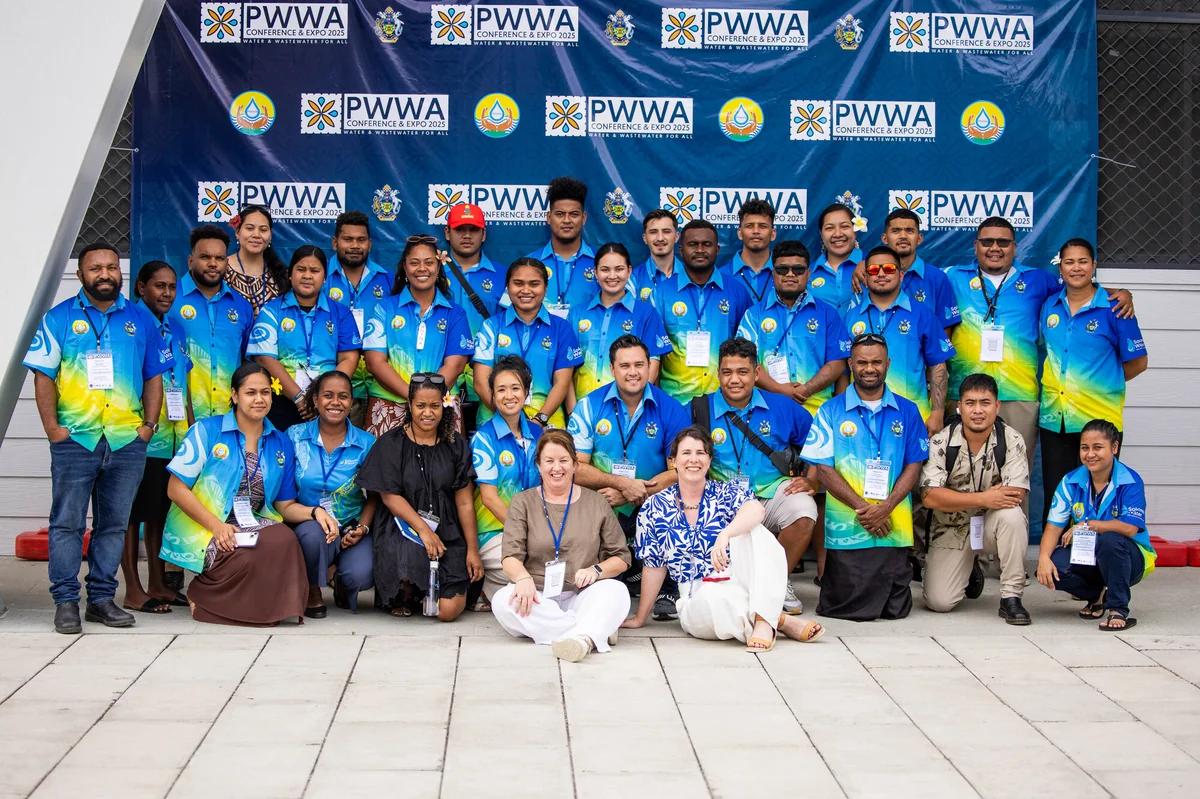
Pictured: The 2025 Young Water Professionals cohort