
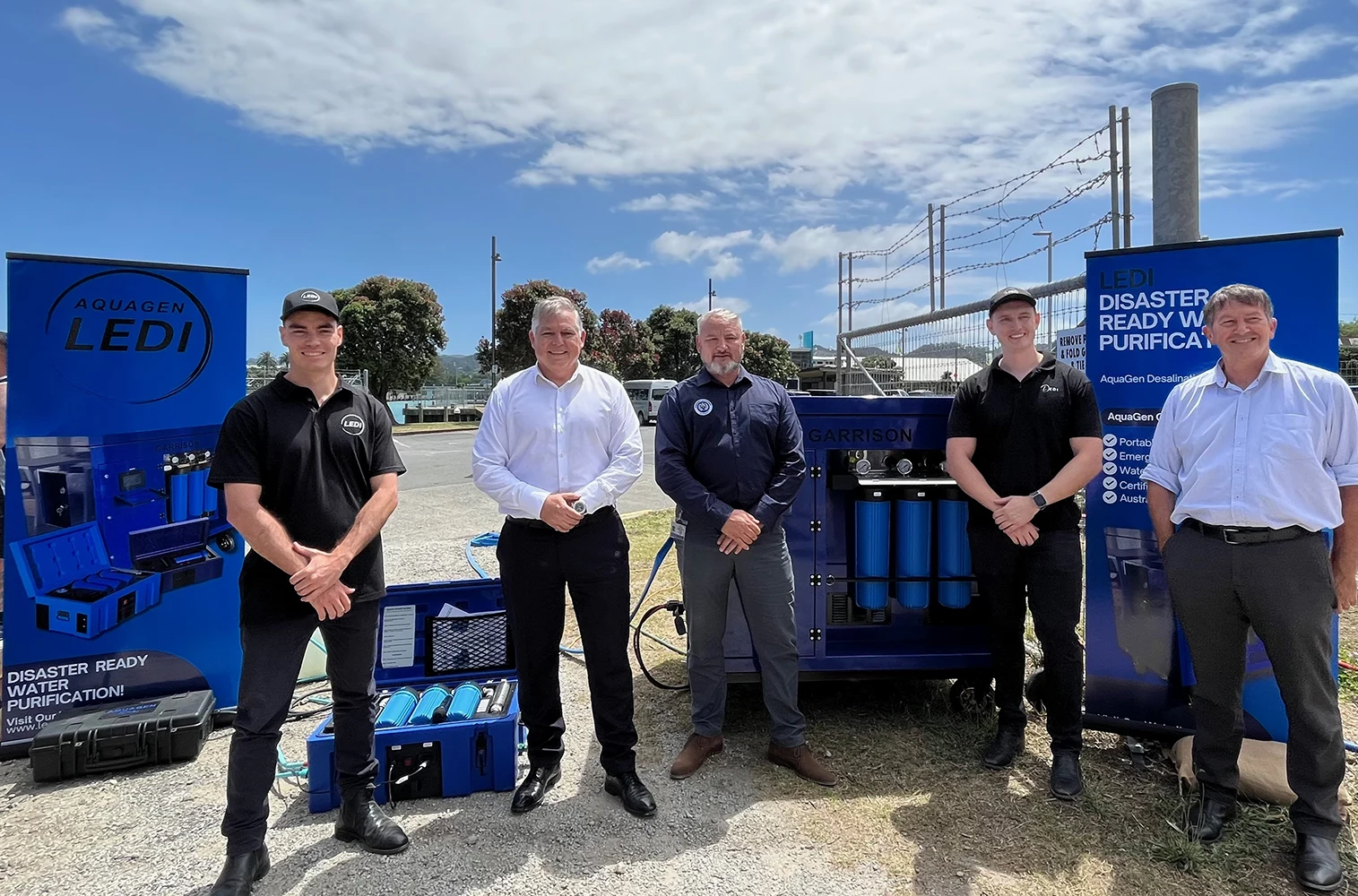
Time spent in war-torn regions with the Australian Defence Force has led an aeronautical engineer to align with a provincial emergency response team in New Zealand to ensure communities have access to clean drinking water during emergencies.
Tairāwhiti Civil Defence Emergency Management Manager Ben Green was looking for a solution to ensure that communities cut off during extreme and catastrophic weather events still had clean drinking water, power, first-aid supplies and communication alternatives. Shipping containers have been delivered to outlying communities filled with the necessary survival tools.
The city of Gisborne, which is home to around 39,000, has a vulnerable 40-kilometre water pipe that failed during Cyclone Gabrielle, leaving the city precariously short of essential drinking water. Green wanted to find a solution that would keep the taps on during such times, albeit only for drinking water, so he set about finding the right person for the job.
Green landed on Dael Liddicoat, whose water treatment device for natural disasters, The Aquagen, seemed to be a possible solution to the issues in the region.
Both men are ex-military, so have a similar way of working through issues to find sustainable solutions. A number of Aquagen units were duly shipped to Tairāwhiti, followed by ‘Garrison’, its (much) bigger brother geared to provide accessible, medium-scale desalination and water purification.
‘My interest in water purification initially started as an aviation-based engineering project to try and solve the challenges we had with deploying purified technical-grade water to remote areas to support our fleet of helicopters,’ says Liddicoat.
Liddicoat says his first experience was when he was deployed in the Solomon Islands in 2019 with a small, simple system. ‘It’s a region that doesn’t have a secure water supply – actually, 33 per cent of the nation lacks access to safe water.’
It got him thinking about more advanced water purification technology, which led to some initial concept designs for what would eventually become the Aquagen. For the next few years, he was focused on his military career and an engineering master’s, so didn’t look to expand the project any further.
In 2022, he was deployed on a United Nations mission to South Sudan, where he was again struck by the apparent water crisis.
‘The city of Juba, where I was based, is connected to the White Nile River. The country itself is heavily affected by flooding, so it’s not water that is the problem – clean water is.’
While working there, he saw the aging and varied water treatment solutions employed that relied heavily on chlorination to treat contaminants. Those on the ground drank mostly imported bottled water.
When Liddicoat returned to Australia in late 2022, he started working again on Aquagen and set up his company, LEDI, as a part-time effort. Fast-forward a few years and he is confident the Aquagen, Garrison and a new micro desalination device currently being worked on will be commercially available everywhere this year.
‘I would love to see these systems – or some variation of them – helping in chronically water-challenged parts of the world or being stored in preparation for future disasters in vulnerable places such as the Pacific … just as they are in Tairāwhiti,’ he says.
He sees it as something both the New Zealand and Australian governments could step in to support. ‘These units can have a real tangible impact on the security and quality of life of our regional neighbours. It would be great to see the units deployed in place of the tonnes of bottled water that support a disaster response.’
Liddicoat says the savings would be significant, but, more importantly, far greater numbers of people would be supported. In 2023, it was estimated that two billion people – 26 per cent of the global population – lack safe drinking water. That number is set to increase to 50 per cent by 2050.
‘Currently, the solutions available to communities are expensive and complex, or don’t quite fit the bill when it comes to producing a quality supply of potable water. Something has to change.’
Both the Aquagen and the Garrison use a three-stage purification process. Microfiltration removes sediment and large bacteria, and reduces chemicals in the water. Next, the water is pressurised in a duplex stainless-steel pressure pump, before going through seawater desalination membranes to remove salt, heavy metals and other dissolved minerals. The system has been modularised so it can be optimised to suit brackish or raw freshwater supplies. Finally, the water is sterilised using a certified UV steriliser that meets the NSF 55 class A grade for treating microbiologically unsafe water, killing any remaining bacteria and viruses in the water.
The efficiency of the system hangs on the use of a brushless power train and advanced axial pressure pumps, meaning it can be powered using a combination of battery and solar power, with a built-in battery enabling the Garrison to produce up to 1000 litres an hour without external power.
‘We have fully automated the operation of the Garrison with proprietary software operating a suite of valves, sensors and controllers internal to the unit. With an installed Starlink, the Garrison can be remotely controlled and monitored.’
At the core of each is reverse osmosis and UV sterilisation – an established and very reliable technology in water purification. With the Aquagen, Liddicoat has extended its reliability with the inclusion of multiple technologies in a system that functions as a personal water treatment plant.
‘It’s unique in that it is super compact, robust and portable, with no user interaction or training required.’
The Garrison is a different beast, and has been designed using the water regulations and rules set by Taumata Arowai – New Zealand’s water regulator – to ensure it enables water suppliers to meet the standard for potable water in an enduring or emergency situation. The unit uses the most advanced functional technology, so even an untrained person can still produce 1000 litres per hour.
‘It’s been designed so a Garrison and generator can be transported on the back of a Hilux. I don’t believe that equipment that provides such a compact and approachable way to generate safe water from any source exists anywhere else in the world.’
Liddicoat and his small team enjoy working with the Tairāwhiti Emergency Management Office (TEMO) crew. ‘Ben and the TEMO team are extremely results‑focused. They are highly innovative and use their military background to formulate extremely effective solutions to problems,’ says Liddicoat.
‘When I walked into the centre, I felt I had stepped back into a military operations room. Our mutual understanding and experience in the sector allows us to work closely together as a team solving problems. It is very motivating.’
Green says both units offer invaluable backup to the wider community. ‘The Aquagen and Garrison emergency water filtration units now deployed in Tairāwhiti exceed what can be deployed nationally,’ he says. ‘You will not appreciate the requirement for water resilience unless you lose your main water supply for an urban centre. Having watched the Solomon Islands earthquake at the end of 2024, I did offer a set of the Aquagen units to be deployed as part of the New Zealand response, given access to safe drinking water is always a priority.’
Next on Liddicoat’s list is a personal desalination device at an affordable price, as well as power generation, communications and the artificial intelligence space. Liddicoat is driven by his firsthand experience with the global water crisis.
‘If I can do anything at all to reduce the growing burden on global water supplies, then I feel that LEDI will have succeeded. There’s not a 10-minute period in a day when I am not brainstorming ways I can make these units better, or create something new to help disaster relief.’