
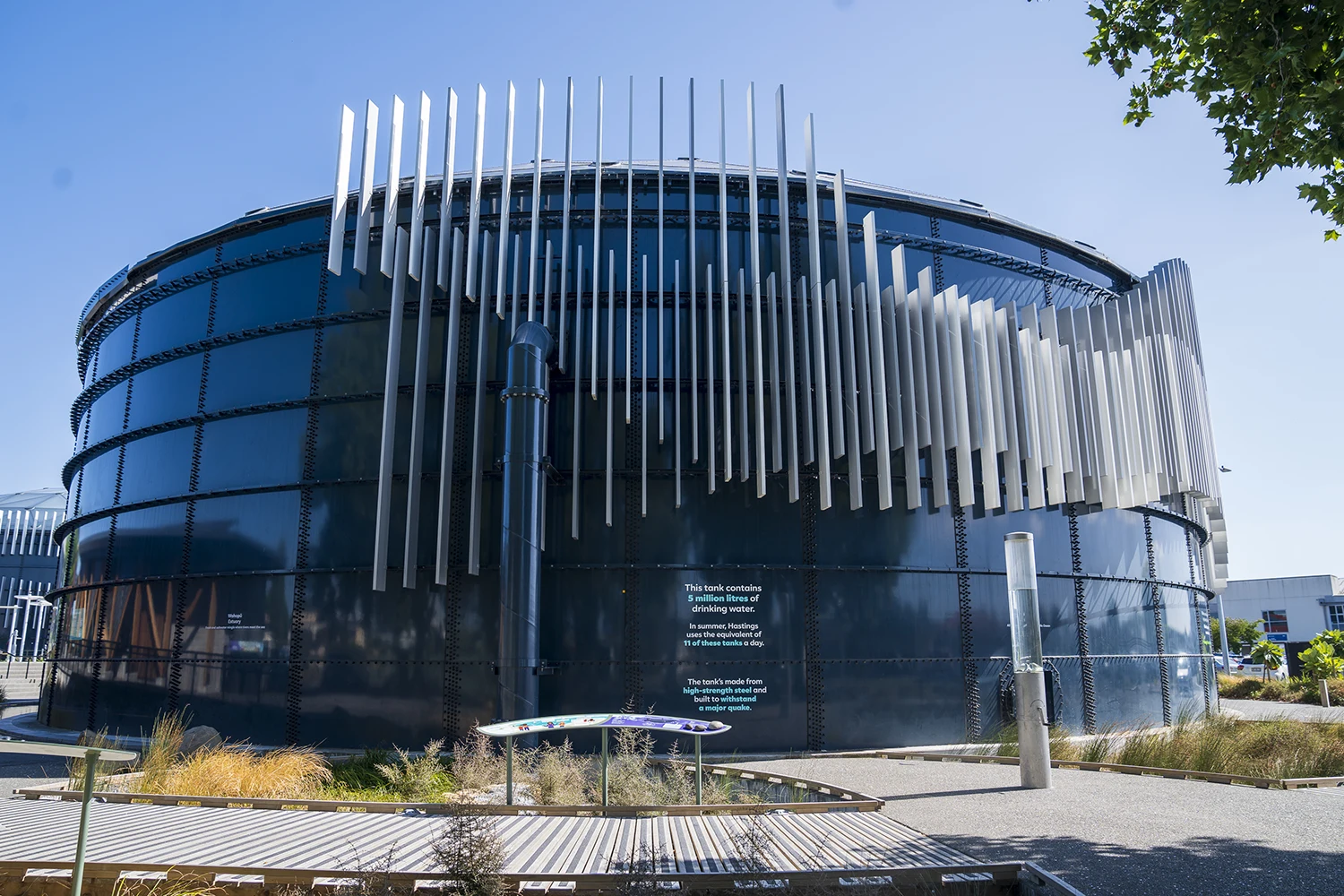
The groundbreaking Waiaroha project brings essential public infrastructure out in the open, and provides a new model for urban water infrastructure – one that enhances the community.
In the heart of Hastings city stands a remarkable sight: two massive five-million-litre drinking water storage tanks rising against the skyline. It’s not where you’d expect to find critical water infrastructure, but that’s exactly the point. Waiaroha is a groundbreaking $39-million project that challenges conventional wisdom about how essential infrastructure is integrated into an urban landscape.
The facility is one component of Hastings District Council’s Drinking Water Strategy, which was developed following the Havelock North water crisis in 2016, when a water contamination event resulted in thousands becoming ill, and contributed to four deaths. The incident shattered a long-held belief that the region’s aquifers were impervious to such contamination, forcing a complete rethink of water management in the district.
‘Before the crisis, our water supply was essentially pulled from the ground, fed into pipes and transported to people’s taps. There was no treatment aside from adding fluoride,’ says Council’s Director of Capital Growth, Graeme Hansen. ‘The need for full treatment became evident to everyone after Havelock North.’
An urban solution
Typically, water treatment facilities are placed away from view in industrial zones or rural areas, but with Waiaroha, Council decided to place it in the city centre. This choice was both practical and symbolic.
The central location positions the facility close to both the water source bores and the network it supplies, saving millions in piping costs. But more importantly, it makes water infrastructure visible and accessible to the community it serves.
The facility’s striking design transforms what could have been an eyesore into an architectural landmark. Working with designers and cultural advisers, the council has created a facility that’s both functional and aesthetically pleasing, proving that industrial infrastructure can enhance rather than detract from urban spaces.
Engineering excellence
At its core, Waiaroha is a state-of-the-art water treatment facility. The 400-square-metre treatment plant uses advanced technology to ensure water safety, while the twin five‑million-litre tanks provide crucial storage capacity. The tanks are built to BRANZ Seismic Resilience IL4 standard – the highest level of seismic resilience, typically reserved for structures that must remain operational immediately after a major earthquake. This level of engineering ensures that the facility can continue providing essential services even in the aftermath of a natural disaster.
Sustainability is integrated into every aspect of Waiaroha’s design and construction. The facility incorporates:
- rainwater harvesting for toilet facilities and garden irrigation
- solar panels for power generation
- permeable concrete surfaces to manage stormwater
- native plantings adapted to local conditions
- use of recycled materials throughout construction.
These features transform what could have been a purely industrial site into an urban green oasis, demonstrating how infrastructure projects can contribute to aesthetic and environmental goals, while still fulfilling their primary functions.
The project was managed in-house by Council’s major projects team, with chief executive oversight and direct reporting to Council’s governance. Quality assurance processes were rigorous, including quantity survey reviews, early contractor engagement, and mandatory NZS3910 contract standards for construction works.
Community integration
A crucial element of Waiaroha’s success has been the partnership with local iwi Ngāti Kahungunu. This collaboration builds on a long history of working together on water projects, including the Hastings municipal wastewater plant that was completed in 2009.
Cultural Adviser Hira Huata played a pivotal role in this project, ensuring that te ao Māori was integrated into the facility’s architectural design elements, the landscaping and the educational elements. This partnership reflects a deeper understanding that water management isn’t just about infrastructure; it’s about respecting and protecting a precious resource that connects all aspects of life.
One of the project’s biggest challenges was winning community support for such a prominent piece of infrastructure. The council tackled this through comprehensive engagement, including extensive consultation with neighbours, detailed communications about safety and aesthetics, and regular updates throughout construction.
‘Given everyone would be paying for it and seeing it, we took a “no stone unturned” approach to community engagement,’ Hansen says. This included door-knocking campaigns by engineers who could address technical concerns, comprehensive FAQs and regular community hui (meetings).
Education a key element
What truly sets Waiaroha apart from typical infrastructure projects is its inclusion of educational facilities within an operational treatment site. The facility includes a purpose‑built discovery centre, and gallery windows along the breadth of the treatment plant allow visitors to observe the complex systems that deliver their drinking water. This transparency – both literal and metaphorical – transforms what could have been an opaque industrial process into an accessible learning opportunity.
The educational facilities, enabled by external funding for the project, weren’t an afterthought; they were incorporated into the core design from the beginning. Engineers worked with iwi and educational consultants to ensure the learning opportunities would be comprehensive and valuable.
The desire to include educational elements actually enhanced the infrastructure project’s efficiency, says Hansen.
‘In endeavouring to make the treatment processes visible and understandable to the public, we achieved clearer system layouts and improved operational monitoring systems.
‘These improvements benefit both visitors and operators, demonstrating how educational considerations can drive better infrastructure design.’
The success of this integration is evident in the facility’s appeal to both schools and community groups, with more than 60 school groups visiting in the first few months of operation. This educational component has transformed what could have been a purely functional facility into a vital community asset that serves multiple purposes.
A model for the future
Waiaroha represents a new model for urban water infrastructure – one that doesn’t shy away from its presence in the community, but rather celebrates being front and centre. By combining essential infrastructure with exceptional design, sustainability features and cultural integration, it demonstrates how utilities can become genuine community assets.
The facility proves that with political will, strong community partnerships and innovative thinking, essential infrastructure can be more than just functional – it can be transformative.
As communities worldwide grapple with aging water infrastructure and increasing environmental pressures, Waiaroha offers an inspiring example of how to turn these challenges into opportunities for community enhancement.
All photographs courtesy of Hastings District Council.