
By Rhiannon Mackie, Greenpeace Aotearoa
Tracing New Zealand’s freshwater degradation.
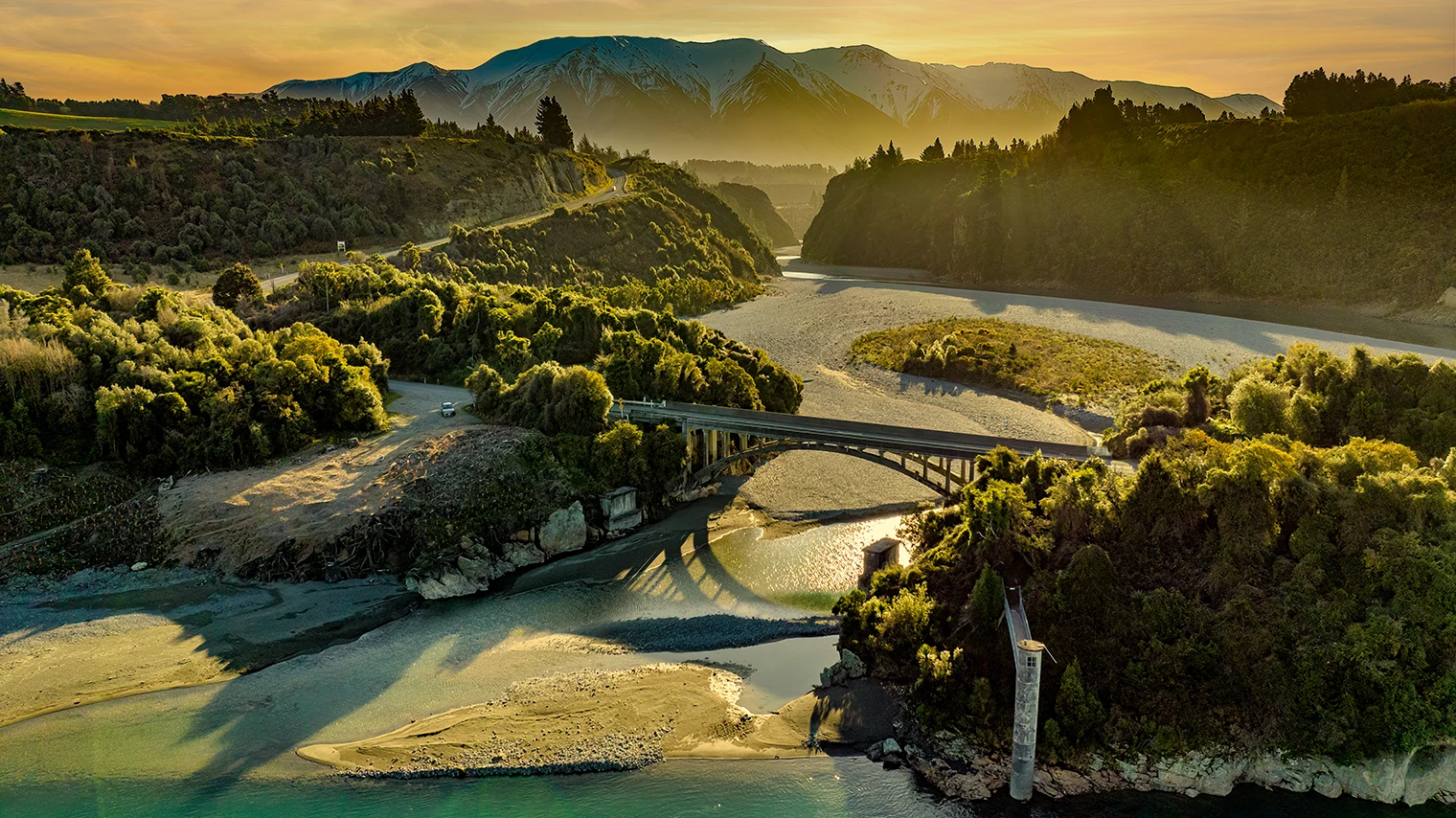
Last year, while filming for a documentary on the state of freshwater pollution in Aotearoa New Zealand, my colleagues and I travelled to Rakaia Gorge, where the head waters feed the river from the Southern Alps. It was the middle of winter and it had been snowing in the mountains; but, despite the cold, that day remains one of my favourite memories of filming the documentary. The river was a clear blue, and I could see all the way to the shingle bottom despite the depth. As kids ran up and down the stony bank, we chatted to a couple walking their dogs who had parked their caravan nearby to spend the night. It was a small fragment of paradise.
We’d travelled into the high country for one simple reason: it’s almost impossible to find a river that looks and acts like a healthy river on the Canterbury Plains – fresh water in Canterbury is in a dire state.
At least 35 per cent of monitored river sites in Canterbury are unsafe for swimming. Many households across the region are unable to drink the water coming out of their kitchen taps due to nitrate pollution. People report getting sick from swimming in the rivers, or catching whitebait that they don’t want to feed to their children.
This is all symptomatic of a wider problem that is threatening New Zealand. Ever since the dairy boom, the state of fresh water in our country has been in sharp decline – something the Ministry for the Environment’s recently released report Our Environment 2025 makes very clear.
Half of all lakes are contaminated by excess nutrients. Ninety per cent of wetlands have been destroyed and 76 per cent of freshwater fish are threatened with extinction. Half of all freshwater monitoring sites are contaminated with E. coli. Alongside this, nitrate contamination in groundwater is increasing in nearly half of all monitoring sites.
The report paints an incredibly bleak picture for fresh water in Aotearoa – one that backs up what environmentalists, freshwater advocacy groups and local communities have been saying for years.
In the past 3.5 decades, intensive dairy farming has become New Zealand’s dominant form of agriculture. As many cows as possible have been crammed onto the land: so many cows that there isn’t enough grass to feed them all without the use of inputs like synthetic nitrogen fertiliser and irrigation.
All of this combines to create a potent cocktail of concentrated nitrogen patches that either run into streams and rivers, increasing nitrate contamination in waterways, or leach into the groundwater supplies, polluting people’s drinking water. Excessive water extraction for irrigation has dried up rivers, reducing water flow, while irrigation dams block migratory fish like tuna (eels) from returning to their ancestral waterways.
The intensive dairy industry, led by Fonterra, is New Zealand’s worst environmental polluter. This is backed by the Ministry for the Environment’s report, as well as by numerous other statistics. Animal agriculture is the largest producer of climate emissions, predominantly due to intensive dairying. It is the largest contributor to the pollution of lakes, streams and rivers across the country. In rural areas, where dairying is extensive, it is the primary polluter of drinking water.
While filming for our documentary last year, we saw the breadth of impacts that intensive dairying has had on fresh water in Waitaha, and the impacts that this has had on everyday Cantabrians. We saw lakes that had been devastated by the long-term impacts of pollution from dairying. Locals told us how the state of rivers has declined within their lifetimes, from pristine to contaminated. Elders spoke fondly of the shingle-bottomed rivers that they swam in, fished from, and collected watercress from as children – stories that did not, by any circumstances, align with what we were seeing on the ground. We saw farms that were mud-farming cattle on Canterbury’s famous braided rivers, with livestock standing in mud surrounded by river rocks.
But the battle for swimmable rivers and safe drinking water is not over yet. In fact, it’s only just beginning.
This year, local body elections will provide a rallying point for people concerned about nature. Local and regional councils can still make changes that will protect their constituents.
Ultimately, as shown in the Havelock North inquiry in 2017, regional councils are responsible for protecting sources of drinking water, which is of paramount importance for the sake of people’s health.
As the Rakaia River travels from its headwaters in the alps towards the sea, it becomes a shadow of its former self. Excessive water takes, permitted by the regional council Environment Canterbury, siphon away the life force of the river for irrigation to grow more grass to feed the oversized dairy herd. Pollution from cattle farms along the banks of the river seeps into the water, contaminating it with nitrate and E. coli.
By the time the river meets the sea, it is merely a trickle of water – a sorry state compared to the beautiful, pristine waters we saw in the highlands last year. But that doesn’t mean that it has to stay this way forever. Regional councils must take action to limit freshwater pollution.