
Major weather events are becoming more frequent, leaving councils to repair damaged assets, protect communities and build resilience. But deciding what needs rebuilding is only part of the job. Getting the work done beside live waterways, between homes or around infrastructure that must keep operating can be just as challenging.
For Kūmānu, how the work will be built needs to be considered alongside what is being designed. Its Big Nature Thinking brings water infrastructure, ecology, environmental management and construction knowledge together to understand the whole site. Early involvement gives that practical knowledge a place in decisions about access, methodology and budget.
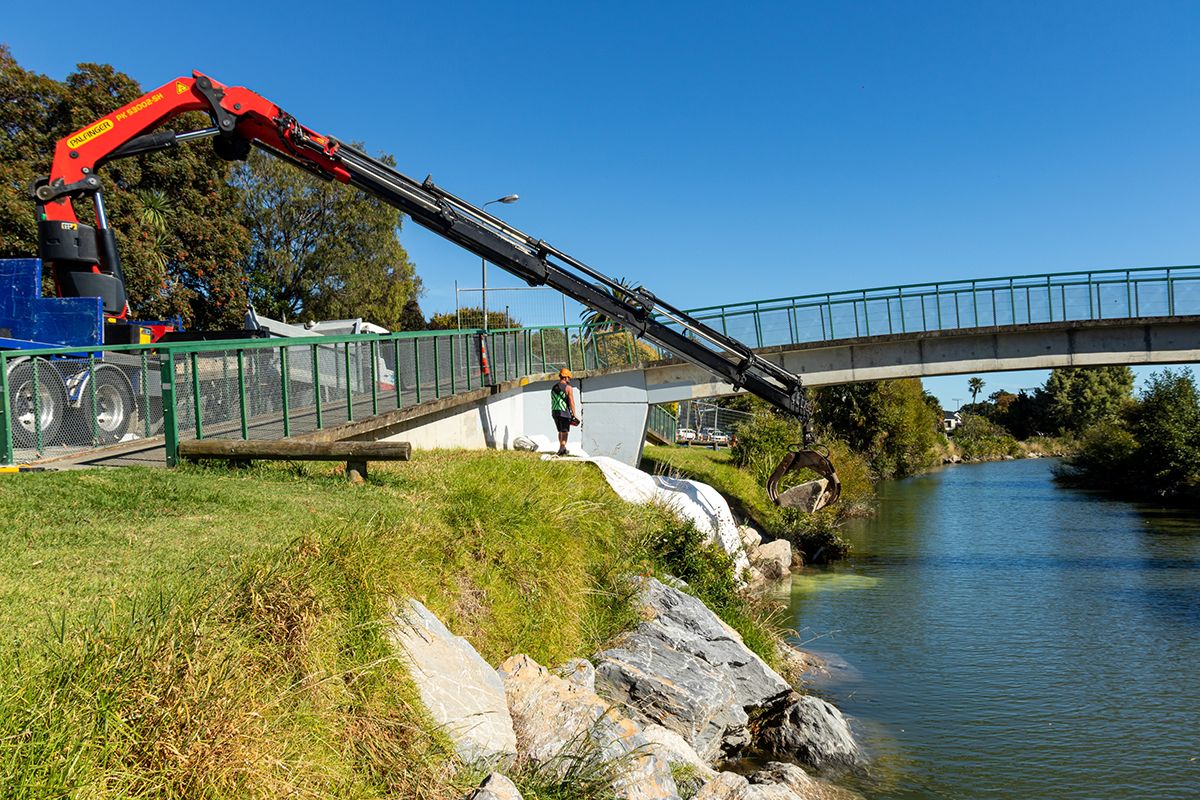
Flood remediation along Nelson’s Maitai River shows why this matters. Heavy flooding eroded the riverbank beside Riverside Pool, threatening sewer and bridge infrastructure, and private property. The work was in full public view, and within an ecologically sensitive reach. There was infrastructure to protect, but the way crews reached and worked in the river also needed careful consideration.
Upstream, the river was diverted away from the work area. The team could work in the dry and limit sediment entering the live channel. The diversion went to plan.
Downstream was a different story. A riffle acted as a grade control, reducing water-level variability. Kūmānu worked onsite with engineers and ecologists to review the conditions and revise the diversion methodology, with an īnanga spawning area immediately downstream for protection.
To avoid more machinery in the river, a crane lowered individual rocks into place, one by one. This reduced disturbance while protecting nearby infrastructure. Tide timing, fish salvage and sediment controls were built into the construction sequence, making the ecological requirements part of how the work was carried out.
Across town, Scotia Street presented a different challenge. Set within a residential area, the stream runs through a steep, canyon-like corridor between private properties. There was little room for machinery or materials, and neighbouring homes were at risk.
Before crews could stabilise the bank, they needed a workable way into the site. Where could machinery operate? How would materials reach the stream? What would the access arrangements mean for neighbouring properties? These questions had a direct bearing on what could be built and how.
Early input into design and budgeting helped Kūmānu shape a buildable, cost-effective solution. The team constructed a crane platform on the adjacent cycleway and a temporary ramp into the stream. Crews then stabilised the bank, constructed grade controls to slow the flow and reinstated fish habitat. The work protected homes and improved the instream environment, which was an outcome welcomed by residents.
Operators and crews bring a close understanding of what equipment can do, how much space a task needs and where a construction sequence may become difficult. That practical knowledge has a place alongside engineering and ecological advice, particularly where access is tight and the waterway remains live.
Kūmānu teams plan low-impact access, manage live water and sediment, and deliver instream improvements on steep or confined sites. When standard methods will not work, they can develop site-specific methodologies and purpose-built tools. Waterways, arboriculture, biosecurity and GIS expertise can also be drawn on as the work requires, particularly during flood recovery when conditions and priorities change daily.
For councils, early input is an opportunity to weigh construction options before committing to a method. Access, temporary works, environmental controls and reinstatement all affect cost and delivery. Considering them together helps make better use of the available budget while keeping the longer-term performance of the asset in view.
The lesson is practical: involve the people who understand the site, the environment and the construction early enough to influence the solution. Then keep those conversations going as the work progresses.
That is Kūmānu’s Big Nature Thinking in practice: bringing infrastructure, ecology and delivery together to protect local assets, make investment go further and build greater resilience for what comes next.
Image: Rock placement at Riverside, Maitai River, Nelson. Image courtesy of Kūmānu