
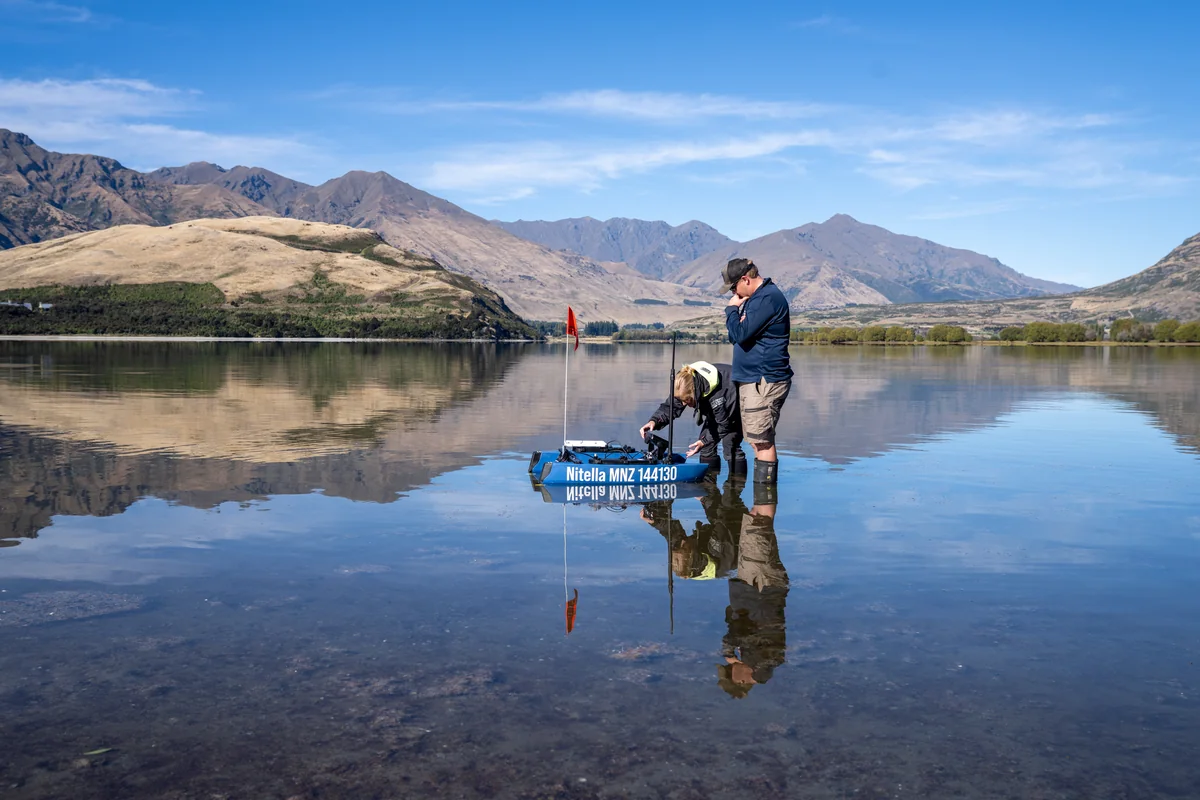
Content provided by the Department of Conservation
New artificial intelligence and remote camera technology promises to transform freshwater weed management.
Phoenix Hale, Freshwater Technical Advisor at the Department of Conservation (DOC), was in a multi-agency biosecurity meeting when he heard about new artificial intelligence (AI) and remote camera weed detection technology being developed by Earth Sciences New Zealand (ESNZ).
‘I was fascinated and keen to know more. Innovation in freshwater pest detection is something we’re very interested in supporting because freshwater weeds are a big and expensive problem.’
Some of the lakes DOC manages on public conservation land are choked with invasive weeds, including Paringa and Ianthe on the South Island’s West Coast.
‘We have a longstanding Lagarosiphon control programme in place at these spots, as well as annual dive surveys and eDNA monitoring at other sites. We’re looking at eradicating weeds in some places to stop further spread, but we just don’t have the tools to understand how widespread and dense the weeds are within those lakes,’ says Hale.
DOC isn’t the only agency that keeps an eye on freshwater pests. Biosecurity New Zealand, Toitū Te Whenua Land Information New Zealand, Te Arawa Lakes Trust, regional councils and others also do this work, with surveillance mostly carried out by divers
‘The promise of new technology that could help us manage these invasive species was really attractive,’ Hale says.
Bringing the essential elements together
Dr Daniel Clements is a freshwater ecologist at ESNZ with a vision for using advanced technology to protect freshwater environments. He led and championed the AI weed detection project.
‘I saw an opportunity to innovate in the biosecurity space by bringing together the quite diverse expertise we have in the institute – AI software detection, engineering for the hardware development and freshwater ecology. There aren’t many organisations where that’s all available in-house,’ Clements says.
The brains of the weed detection system is a ‘module’ – basically a computer that’s been trained on what to look for – protected inside a plain Pelican case with submersible cameras attached.
‘It’s designed so you can deploy it from crewed vessels, fully autonomous boats or remotely-operated submersible vehicles.
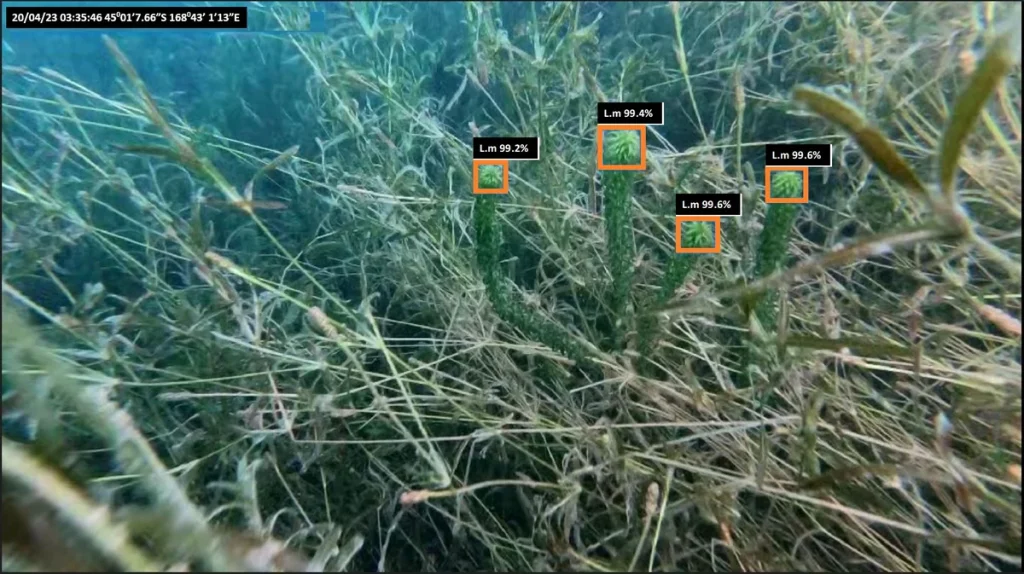
‘The camera’s taking video underwater. When the software identifies a target in the frame, it records the GPS location, time and number of instances. Then you can send divers to those specific locations to control the pest, instead of having to use people for lake-scale surveillance.’
Clements says it’s exciting to have got to the stage of a working prototype.
‘The technology is at a point where the AI and camera systems are coming together. We’re operating on the edge and pushing the boundaries of this real-time detection to keep it moving forwards.
‘We couldn’t have got this far without DOC’s support. Their knowledge of what’s required to manage and potentially eradicate weeds, and their shared vision for the project, has helped us shape the tech and get us past the initial limitations.’
Hale has also enjoyed the collaboration. ‘You just never think about some of these things … like the technical challenges of trying to get a camera to automatically avoid hitting the lakebed or other obstacles in the water column!’
First step: to look for lagarosiphon
DOC has supported the development of the technology specifically for detecting lagarosiphon – an invasive weed that is fast-growing and quickly smothers native habitat in lakes.
‘We chose Lagarosiphon to work on first because its potentially eradicable from specific lakes if caught in an early stage of invasion,’ says Hale. ‘It’s also relatively easy to identify. Lagarosiphon probably arrived in New Zealand as an oxygen weed from an aquarium, and spreads by fragments being carried to new sites at existing lakes and into new lakes. Interestingly, all the plants we have in Aotearoa New Zealand are female, so it doesn’t spread by making seeds here. I guess that’s something in our favour.’
Another bonus is that Lagarosiphon really stands out when viewed underwater.
‘The growing tips look like little light bulbs among native freshwater plants. That’s really helped with training the AI system to recognise it correctly,’ Clements says.
Some work to develop an AI detection method for hornwort – recognised as New Zealand’s worst freshwater weed – has also been carried out as part of the DOC-ESNZ partnership.
Benefits of early detection
Controlling a weed when it first invades is, on average, 40 times cheaper than controlling it once it’s widespread. Freshwater weeds can hide under the surface of lakes, quietly spreading without being noticed. By the time they hit the surface, it can be very expensive or even impossible to deal with the incursion.
‘This new tech gives us a window of opportunity to detect and manage early-stage infestations. It means we can divert resources from searching into actually doing control work,’ Hale says. ‘We’ve got a real opportunity in New Zealand because many lakes have clear water where this technology really shines.’
ESNZ is also working on detection of other invasive species, including Caulerpa and Mediterranean fanworm in the marine environment. Clements also sees applications for the technology beyond freshwater biosecurity, and beyond New Zealand.
Calling potential users to help shape the technology
The prototype technology is now at a stage where input and collaboration from potential end users is required to help refine and test the systems. Toitū Te Whenua Land Information New Zealand and Boffa Miskell have already been involved.
‘We’re looking for end users and those willing to support us to help take it through to being ready for use in the field. The more engagement there is, the more the tool can be tailored to the specific needs of those who will use it.’
Hale says the DOC is keen to continue developing and using the technology.
‘This is a real opportunity to streamline how we look after freshwater ecosystems on public conservation land. It’s an exciting time to have more tools becoming available – that’s what the biosecurity system is screaming out for.’
How you can help
Always check, clean and dry your gear thoroughly between waterways. Lagarosiphon, hornwort and other invasive species can be spread to a new site by tiny fragments of weed hitching a ride on your boat, waders or fishing gear. 
Get in touch with Earth Sciences New Zealand if you’d like to collaborate or talk about becoming an investment partner to support the project.