
By Monica Hoetjes, Environmental Engineer, Beca
West Coast Regional Council and Buller District Council have been exploring whether rain gardens could provide an effective nature-based solution to Westport’s recurring flooding. With intense rainfall events becoming increasingly frequent, both councils are considering whether this stormwater tool – traditionally used at a small scale – can be adapted and deployed more broadly across urban areas.
When we consider nature-based environmental solutions, we begin by asking what pressures the environment and community are facing. Is the area prone to flooding or drought? How would the land behave without human intervention, and could restoring or mimicking natural processes help reduce impacts on people?
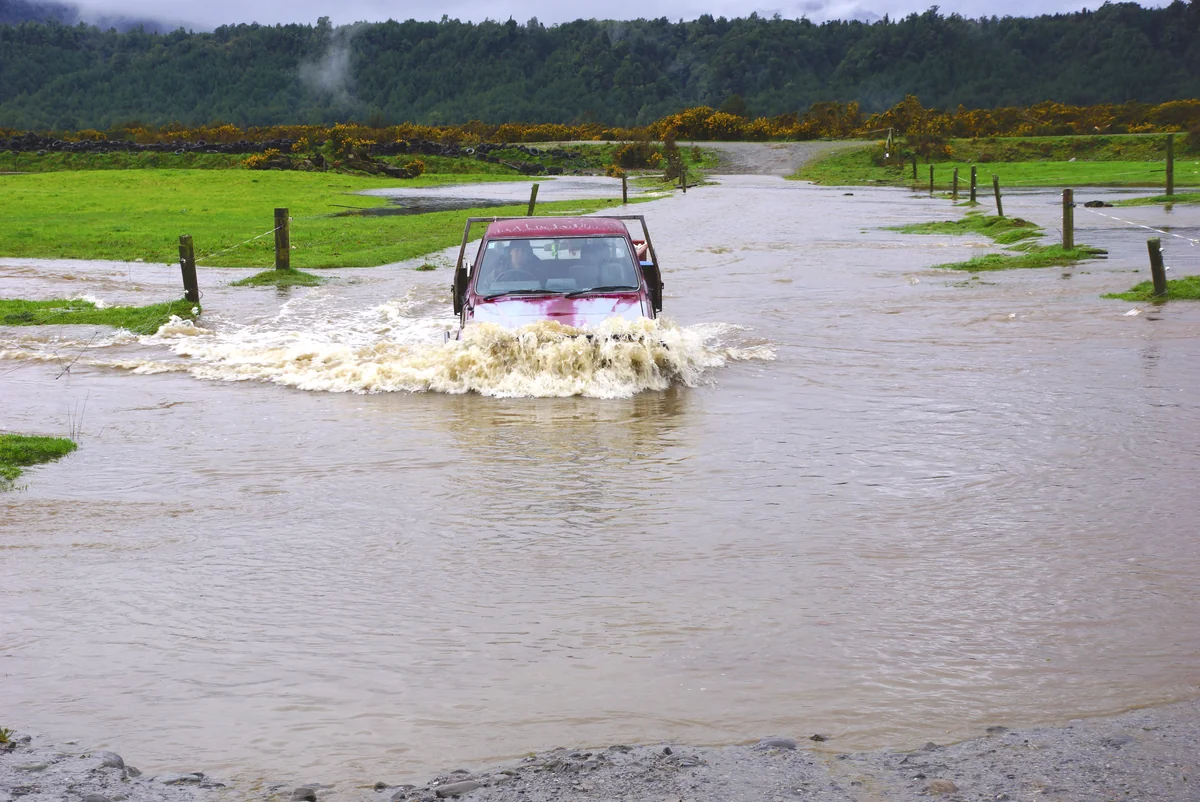
Rain gardens are typically used in urban environments to treat stormwater and manage run-off from frequent, low-intensity rainfall. In Westport, however, the challenge is different. The town experiences ‘nuisance’ flooding roughly once a month, with water regularly pooling on roads and footpaths, and outside schools and homes. With the existing stormwater network already operating at capacity, alternative approaches are needed to supplement Westport’s stormwater management.
While rain gardens are widely used across Aotearoa New Zealand to manage small, frequent storms and improve run-off quality, they are not commonly applied for large-scale flood mitigation; however, Westport’s urban form presents a unique opportunity. Many of the town’s streets have wide road corridors with expansive grass berms, on-street parking and generous vehicle lanes. This creates room to ‘make space for water’ without major disruption to existing activities.
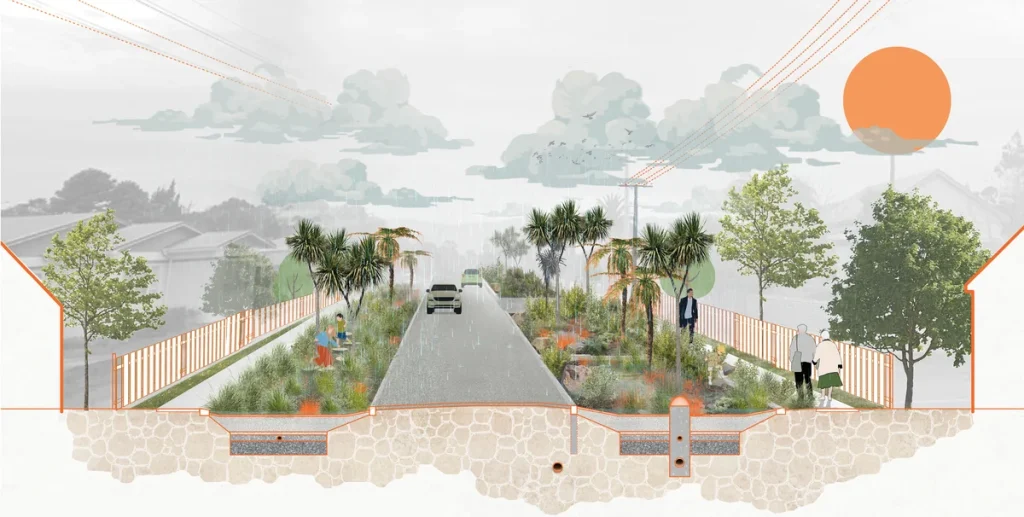
Proposed Westport rain garden in section
Developing a concept design
Nature-based design requires an integrative approach. As such, the Beca design team combined the expertise of Landscape Architect Emma Content, Civil Engineer Ben Melvin, and myself – an Environmental Engineer.
Together, we collaborated with both West Coast Regional Council and Buller District Council to identify a suitable case study location. The site was selected because it consistently experiences surface ponding and has enough available space to trial different rain garden configurations. For this site, we developed a concept design incorporating large rain gardens and assessed their capacity to collect, detain, and convey stormwater during heavy rainfall events.
Because rain gardens in New Zealand have traditionally been designed for water quality treatment rather than large-scale flooding, we took a different approach to sizing. Instead of relying solely on existing guidance, such as Auckland Council’s Stormwater Management Devices in the Auckland Region (GD01), we worked backwards from the available space to understand the storm events the rain gardens could realistically manage. Ground surface levels, groundwater depth and existing services were all considered.
Design options
Two rain garden design options were tested – a conventional approach and a more innovative concept:
Option A: Conventional approach
This option involved rain gardens fitted entirely within the existing grass berms. This approach aligns with conventional design practice, such as Auckland Council’s GD01, but offered limited benefit for larger storms. This is consistent with the intended purpose of typical rain garden design guidelines.
Option B: Making space for water
This option involved rain gardens built by narrowing vehicle lanes and reallocating road corridor space. By narrowing the road corridor, larger rain gardens could be created, comprising roughly 6–7 per cent of the total catchment area.
This option showed strong potential to store and infiltrate run-off across a wide range of high-intensity and short-duration rainfall events – events that currently exceed the stormwater network capacity and result in localised flooding. Water balance modelling was used to quantify the expected impacts.
Benefits beyond flood mitigation
Beyond reducing flooding, rain gardens provide ecological and social value. Westport currently has few street trees, so rain gardens offer an opportunity to introduce layered, locally appropriate planting and establish ecological corridors through Westport’s urban area.
These planted systems also improve visual appeal, encourage walking and cycling, and provide spaces that contribute positively to community health and wellbeing. Additionally, rain gardens enhance the quality of water discharged into the Buller River and Orowaiti Lagoon, capturing sediment and pollutants through settling, filtration, and plant uptake.
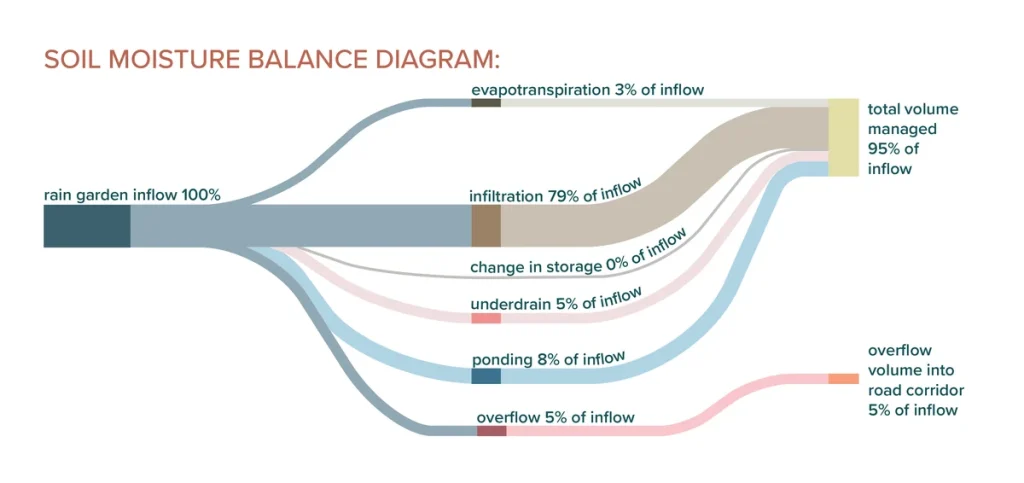
Soil moisture balance diagram
Modelling and early findings
To better understand the long-term performance of Option B, we developed a theoretical water balance model using historical daily Westport rainfall and evaporation data from 2022–24. The model tracks how water moves through the rain garden system over time – how much is stored and transpired by plants, infiltrates, drains via underdrains, or flows back onto the road once capacity is exceeded.
The model indicates that the rain garden at the case study site could manage approximately 95 per cent of all rainfall during the 2022–24 period without overtopping.
We also modelled soil moisture dynamics using a water balance approach to inform soil composition and planting decisions. The modelled soil blend of 30 per cent sand, 30 per cent compost, and 40 per cent silt/clay was theoretical, and provided us with target soil properties to avoid prolonged soil saturation and over-drying. The modelled soil mix contained a high proportion of compost and may be susceptible to elevated nutrient leaching. Further work is therefore needed in the next design stage to refine the mix using locally available materials that can help mitigate potential nutrient leachate. Other organic sources, such as bark fines or mineral-dominant material, may be alternatives.
The concept design and water balance model were presented in poster format at the Stormwater New Zealand Conference 2025 and won Stormwater Poster of the Year.
Scaling the approach across Westport
Following the case study, the councils asked the Beca team to assess how the case study rain gardens could be applied elsewhere in Westport. We worked with West Coast Regional Council and Buller District Council to identify other areas where flooding is an issue, and compared the available berm and road corridor space with the rain garden footprint required to achieve similar performance to the case study design.
This feasibility assessment suggests that a broader rollout is possible, including for a catchment between two schools where flooding frequently disrupts access.
Next steps
The next phase will involve detailed design and onsite pilot trials, which would test how well the theoretical model performs under Westport’s conditions using design soil mix and local plant species. The pilot trials will also help to refine design considerations, such as maintenance, construction methods and long-term performance.
While more analysis is needed to quantify how rain gardens might complement and extend the life of existing stormwater assets, the early findings strongly suggest that they could play an important role in reducing pressure on the network. The councils are encouraged by the findings so far.
Rain gardens have not traditionally been used at this scale or for flood mitigation in New Zealand; however, with robust modelling, careful design and real-world testing, the Westport project demonstrates the potential for nature-based solutions to support climate resilience beyond the current typical use.
Our case study has shown that these larger rain gardens are effective at managing the short-duration and high-intensity rainfall events that tend to exceed the capacity of the stormwater pipe network and result in localised flooding.
Often when we design large-scale flood mitigation works, we forget or negate the more day-to-day flooding at people’s doorsteps, which impacts their quality of life, and this work has highlighted how rain gardens could be useful in integrating with catchment-scale works.
As rainfall patterns continue to change and flood events intensify, this approach may offer a valuable template for other regions facing similar challenges. 
About the author
Monica Hoetjes is an Environmental Engineer based in Beca’s Christchurch office, who works across a range of flood risk and stormwater management projects.