
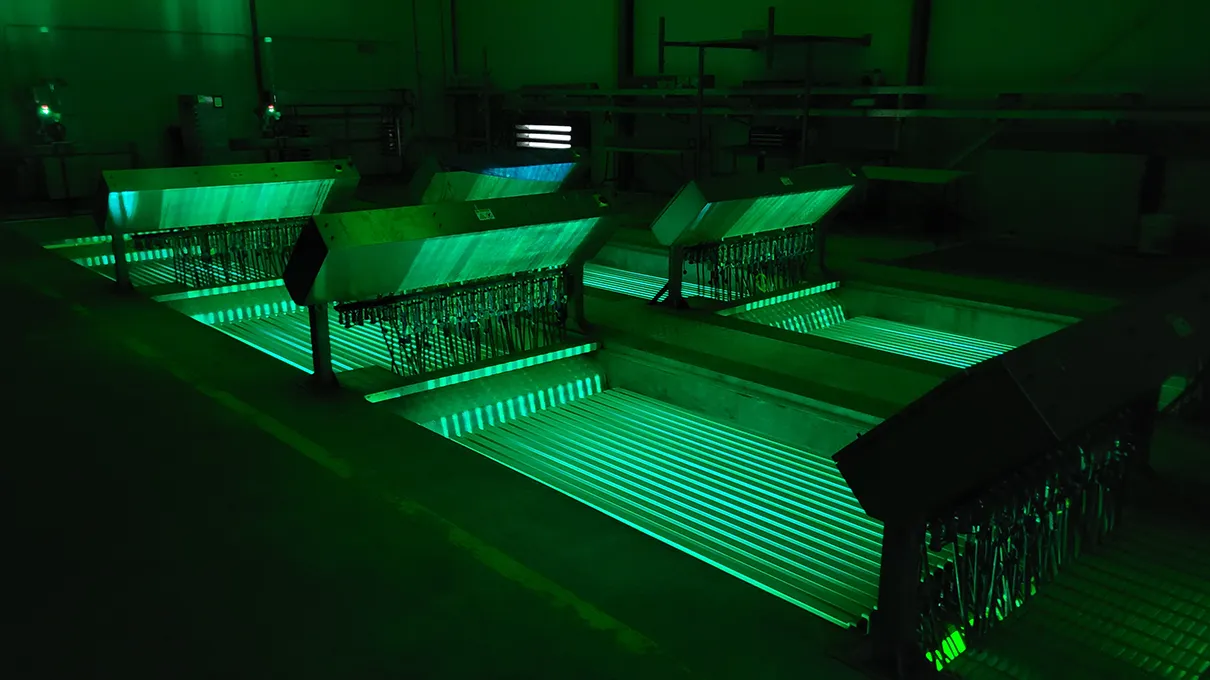
As part of Dunedin City Council’s commitment to sustainable and environmentally responsible wastewater management, the Tahuna Wastewater Treatment Plant has adopted an advanced ultraviolet disinfection system. This innovative technology offers a chemical-free way to ensure the city’s treated wastewater is safe for both the environment and the community.
Ultraviolet (UV) disinfection provides a sustainable, cost-effective and environmentally friendly way to inactivate harmful viruses and bacteria from wastewater before reuse or discharge into the environment. Global studies have shown that UV treatments are effective at scale, and are particularly effective at removing spore-forming parasites and Giardia lamblia – a microscopic, single-celled parasite that causes illness.
At the Tahuna Wastewater Treatment Plant (WWTP) in Dunedin, which serves 120,000 people, specialised UV lamps are submerged in the wastewater. These lamps emit a specific wavelength of light that inactivates viruses and bacteria, preventing them from reproducing.
Before the upgrade, the plant used primary sedimentation followed by chemical disinfection with chlorine to treat wastewater.
‘UV technology offers a chemical-free way of disinfecting wastewater and reduces the requirement of a chemical disinfectant,’ says Dunedin City Council Acting Group Manager Three Waters John McAndrew.
‘It also removes the risks associated with chemical handling, storage and cost.’
McAndrew says that an additional benefit of UV disinfection is that it does not alter the properties of the treated water. This means that no other chemicals need to be added to the water before discharge into the environment – further reducing costs.
‘One of the best advantages of UV disinfection when treating wastewater is that there is no chemical residual that can be harmful to humans or aquatic life when the treated water is discharged to the environment,’ adds McAndrew.
‘UV disinfection is the most environmentally responsible disinfection for wastewater discharged to the environment.’
In addition to being chemical-free and environmentally safe, UV disinfection systems have a low carbon footprint and are inexpensive to operate. They are also safer for the operations staff.
McAndrew says that the six-bank Trojan UV system can increase and decrease the power it uses based on environmental factors such as water quality and flow. ‘Banks of lamps can be turned off if not required and even reduce their power automatically through smart feedback from onsite instruments.’
Strong performance outcomes have been observed since the UV system was installed at Tahuna WWTP, with Dunedin City Council employees spending less time servicing and maintaining the asset, reducing overall cost of ownership.
‘Recently, specialist Trojan Wastewater UV experts Aquatec Maxcon New Zealand were engaged to service and maintain the council asset. They brought with them decades of working on this exact equipment and the system is operating very well,’ says McAndrew.
There are similar Trojan Technologies UV systems in more than 100 countries, and the UV system at Tahuna WWTP is part of the largest municipal UV installation base in the world.
‘The selection of the equipment was based on a multitude of factors, including installation and operational cost, operational flexibility, and features that are patented and unique like the wiper system, lamp configuration, lamp life and validity also contributed to the selection,’ says McAndrew.
While the Tahuna WWTP is currently performing well and within its consent, the UV wastewater system has built‑in flexibility that futureproofs the WWTP for years to come.
‘When the UV at Tahuna was designed, future expansion was a consideration, and it can be expanded easily at low cost when required.’