
By Helen Castles, Te Tai Tokerau Water Trust
In a time of increasing climate volatility and economic uncertainty, Te Tai Tokerau Water Trust has developed a regional infrastructure delivery model that could transform the Northland Region.
Created in 2020 to drive sustainable water storage development, Te Tai Tokerau Water Trust (TTTWT) is building three large reservoirs in the Mid North and Kaipara. When fully completed, there will be sufficient infrastructure to develop more than 2500 hectares of horticulture, creating hundreds of jobs and millions of dollars of annual regional output.
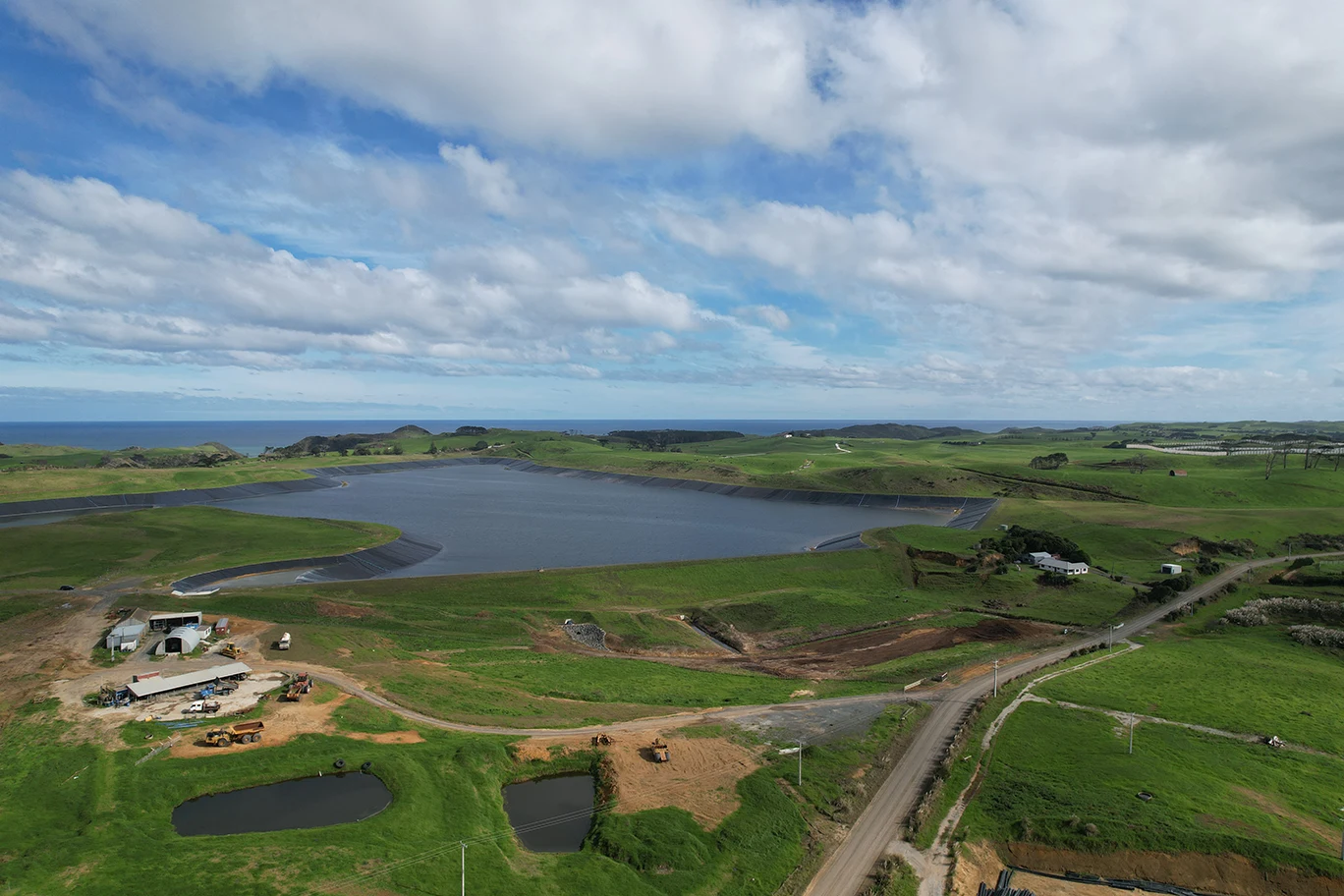
Matawii in Kaikohe is the first of the storage projects to be finished and can hold up to 750,000 cubic metres of water. Te Waihekeora, south of Dargaville near Te Kōpuru, was finished last year. TTTWT is now working to build a 22-kilometre pipeline so the reservoir can supply water to Dargaville township and its surrounding areas, including securing a reliable water supply for Silver Fern Farms.
The third reservoir, Otawere, at Waimate North, will be completed later this year.
The TTTWT delivery model is fast becoming a blueprint for water projects in other parts of New Zealand.
Northland’s vulnerable water landscape
Northland, or Te Tai Tokerau, is a region defined by its rugged, diverse beauty. It’s rich in Māori culture and history, and renowned for its stunning coastline and beaches – not to mention lush native forests and vegetation; however, the region is also one of the country’s most economically challenged areas. Northland struggles with issues related to employment and underinvestment.
For decades, the region has been troubled by drought. Insufficient water storage and infrastructure systems in places with highly valuable soils have made matters worse. It’s left farmers and Māori landowners vulnerable, and unable to fully utilise their whenua.
The lack of water security has been a major economic barrier – until now.
Te Tai Tokerau Trustee Dover Samuels says a good example of this is the township of Kerikeri in the east and its poorer cousin, the township of Kaikohe, in the west.
‘You just have to look at Kerikeri to see what a reliable source of water can do for a community,’ says Samuels.
The Kerikeri Irrigation Scheme is the main water supplier to the Kerikeri township, which is well known for its horticulture endeavours.
A bold vision for water resilience
The TTTWT was established to design, fund and oversee the development of long-term water storage solutions that can support regional land use change and economic development.
The TTTWT’s mission is focused on economic and social transformation unlocking the potential of land. It was created as a vehicle to bring together local and government leaders, iwi representatives, farmers and growers, and infrastructure experts.
The funding model
The TTTWT acquired funding through the government’s Provincial Growth Fund. At the time, Shane Jones was the Minister for Regional Economic Development. A Northlander himself, he realised the value in a secure water supply.
‘A key justification is to accelerate Māori development on land to create jobs and resilience in the land,’ said Minister Jones. ‘If you don’t have irrigation or water, the land is just an emotional heirloom.’
Minister Jones was instrumental in the establishment of the TTTWT. He secured $12 million for Matawii Reservoir under the COVID Fast Track, followed by additional loans for two other major reservoir projects, Otawere and Te Waihekeora. It brought the total funding to more than $66 million, which is to be paid back over time.
‘What we sought to promote was using the Crown balance sheet to meet the up-front cost of creating water storage in those areas where there is underdeveloped Māori land. I think that is absolutely the way to go,’ said Minister Jones.
The TTTWT’s model isn’t completely dependent on Crown funds. Local landowners and businesses can purchase shares in the water projects, entitling them to a fixed volume of water per annum and a fixed rate of supply.
This co-investment model means landowners are not just customers, but shareholders and, eventually, owners of the infrastructure. Over time, the schemes are designed to transition into community or cooperative ownership.
Shares were initially purchased for around $30,000, entitling a shareholder to 3000 cubic metres of water per year.
The community benefits
The benefits of the TTTWT’s work are far-reaching. The new reservoirs will enable irrigation of up to 2500 hectares of farmland across the Mid North and Kaipara. This is expected to double in time with futureproofing considerations. For a region traditionally limited to lower-value agriculture, this opens the door to higher-value horticulture ventures such as kiwifruit, berries and more.
Kaipara hapu, Te Uri O Hau, is one Māori landowner that’s making the most of the new Te Waihekeora Reservoir near Dargaville and is now a shareholder.
The availability of an ongoing supply of water has enabled the establishment of a 20-hectare avocado orchard on the Pouto Peninsula, just 100 metres from the reservoir.
The orchard was part of an overall strategy to entice whānau back home, ensuring employment opportunities and tapping into a market worth $230 million a year to the Aotearoa New Zealand economy.
‘This was a major step for Te Uri o Hau. We’ve been wanting to utilise our land to create jobs and a better way of living for our whānau, and we saw avocados as a means, but wouldn’t have been able to do it without irrigation and that reservoir was a lifeline,’ says CEO Jonathan Rishworth.
The implementation of the water schemes will boost Northland’s economy. It will also benefit whānau, small‑scale growers looking to diversify, and young people in search of stable, well-paying jobs in their communities.
A community solution
Droughts are common in the summer months for Dargaville and its surrounding areas. Last summer, less than five millimetres of rain fell in the month of February. Tinder-dry conditions forced residents into Level 4 water restrictions – the toughest restrictions possible.
Water deliverers were banned from using the town supply, forcing rural residents to get their water from outside the district.
The Te Waihekeora Reservoir has been touted as the district’s solution to its water woes.
Minister Jones announced a $17.5-million loan to build a 22-kilometre pipeline from the reservoir to Dargaville, the funding coming from the Regional Infrastructure Fund.
TTTWT Chairman Murray McCully says the pipeline will provide water to about 3000 hectares of potential horticultural land in the area, as well as Silver Fern Farms – one of the district’s largest employers.
‘The town has suffered under these Level 4 water restrictions, and I think is desperate for a solution that we’re pleased to be able to provide,’ he says.
The pipeline will likely be completed in 2027.
Infrastructure: reservoirs designed for the future
Te Tai Tokerau’s infrastructure portfolio currently includes three reservoirs:
- Matawii Reservoir (Kaikohe): A 750,000-cubic-metre reservoir that supplies water to nearby farmland and an industrial zone, including a potential food processing hub. This reservoir was the first completed and represents the proof-of-concept for the broader scheme. Key shareholders include the Far North District Council and Far North Holdings Limited.
- Te Waihekeora Reservoir (Te Kopuru): At 3.3 million cubic metres, this large-scale, high-density polyethylene–lined reservoir is a game changer in this community. It will feed into a piped distribution network that spans dozens of land blocks and farms.
- Otawere Reservoir (Waimate North/Ōhaeawai): Currently in development, this four-million-cubic-metre reservoir will be the largest and provide water for a fast‑growing horticultural zone. The government has loaned an additional $24 million connecting Otawere Reservoir to the Matawii Reservoir.
Governance and ownership: keeping it local
Another feature of the TTTWT is its commitment to local governance. While TTTWT is the central delivery agent, each reservoir project will eventually be managed by its own water company, made up of the users and shareholders in that area.
This model means that decisions are made close to the ground by those directly affected. It also creates a high level of transparency and accountability, ensuring that the schemes are run efficiently and fairly.
TTTWT manages the development, but the ultimate goal is to hand the keys over to the people, landowners, iwi and farmers who rely on the water every day.