
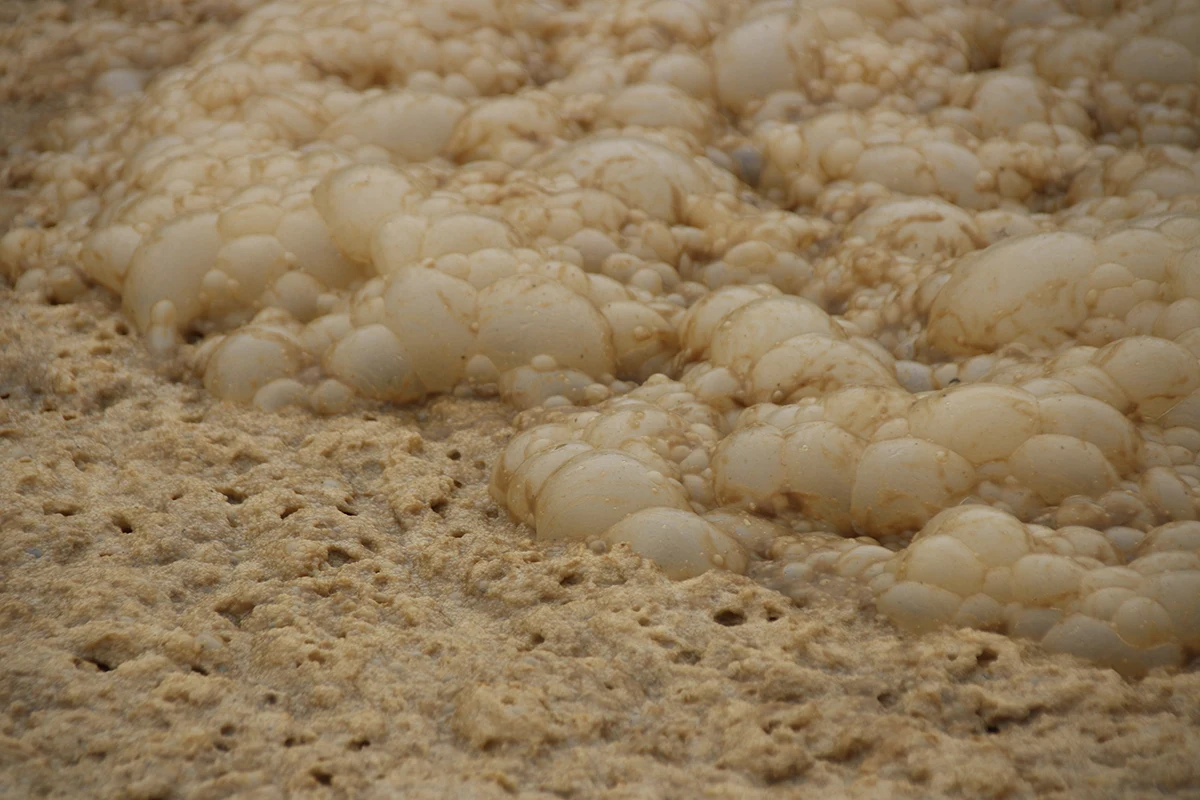
A parasitic organism may hold the key to a cheap, simple and environmentally friendly way to treat wastewater foaming, researchers have discovered.
Wastewater foaming is a costly operational disruption that can slow water treatment down to a halt and is notoriously caused by a filamentous bacterium called Gordonia amarae (formally known as Nocardia amarae).
While trying to understand this filamentous organism, La Trobe University researchers in Australia isolated the novel bacterium Mycosynbacter amalyticus – dubbed ‘microbial dark matter’ by scientists – and discovered that it has the power to disrupt the growth of other bacteria, like Gordonia amarae.
The initial isolation and characterisation of this bacterium, along with the details of this work, was published in the Nature Microbiology journal in 2021. This discovery was exciting for two major reasons – first, this was the isolation of the first environmental microbial dark matter. Second, it is the first biological entity shown to kill Gordonia amarae.
The microbial dark matter is routinely detected in bacterial surveys; however, nobody seemed to be able to grow it in pure culture, so how they grew and existed in the community, and what they looked like, was completely unknown.
The mystery behind these organisms led to speculation that they adopted a unique lifestyle that is different to most other bacteria, likely being nano-bacteria and parasitic, ultra-small, and with a dependency on a host organism for survival.
As it turned out, much of the speculation was correct, with the added bonus being that this organism also displayed a potent ability to rapidly kill its host – Gordonia amarae – and other related species implicated in wastewater foaming.
In addition, not only does it kill rapidly, this organism specifically attacks Gordonia amarae and other close relatives, also referred to as ‘GALOs’ (Gordonia amarae–like organisms), leaving other import members of the wastewater community untouched.
This targeted ability to kill its host creates the potential for development of a biological tool that doesn’t require the use of toxic chemicals in treating these wastewater foaming events. Lead researcher Dr Steve Petrovski, Associate Professor in Microbial Genetics in the School of Agriculture, Biomedicine and Environment at La Trobe University, says his team investigated how this parasitic organism might impact the role of the bacteria Gordonia amarae.
Petrovski’s research group has been searching for a biological alternative for years – by screening and isolating viruses that have the ability to kill their host bacteria – to try to control their overgrowth. Over time, Petrovski’s research group has created a large collection of these viruses; however, despite their best efforts, nothing was ever found to kill the most notorious foaming bacterium, Gordonia amarae, until the discovery of Mycosynbacter amalyticus.
Foaming in wastewater interrupts the treatment process and costs the industry a significant amount of money to control with environmentally damaging chemicals.
Petrovski says Gordonia amarae contains a compound in its cell wall known as mycolic acid, making the surface of these bacteria hydrophobic. This is what makes this organism problematic and able to stabilise foam in wastewater.
In their latest research, published in April in Nature Communications, the team of scientists discovered that the parasitic Mycosynbacter amalyticus targets and attaches itself to the mycolic acid coating the surface of Gordonia amarae, before killing it.
Importantly, they found that, in response, the host organism (Gordonia amarae) would naturally mutate to avoid parasitism by shedding its ability to produce mycolic acid, resulting in slow-growing daughter cells that are no longer hydrophobic.
By avoiding the parasitism of Mycosynbacter amalyticus, the mycolic acid–deficient Gordonia amarae cells permanently lose their ability to stabilise wastewater foam, but maintain their presence in the community.
This exciting news indicates that the addition of this parasite will result in non-problematic Gordonia amarae, solving the problem of over-proliferation and hydrophobicity.
Dr Debnath Ghosal and his team from the School of Biomedical Sciences at The University of Melbourne helped prove this using high-resolution, sophisticated microscopy. The high-resolution microscopy used is powerful enough to image the surface of these bacteria, allowing the researchers to observe changes in the structure of the cell wall.
This helped provide one of the key pieces of evidence to suggest that the mycolic acid was no longer incorporated into the cell wall.
In addition, this high-powered microscopy helped uncover structures on the surface of the parasites that are believed to be involved in the attachment to their host Gordonia amarae – structures that have never been observed in other bacteria, indicating a unique lifestyle.
The evidence collected in this study led to the hypothesis that these nano-bacteria deploy filaments that extend from the surface of the parasite that behave as ‘grappling hooks’, which, once attached to the mycolic acid surface of the host, the parasites retract to pull themselves into contact with their host. They use a lance-like surface protein to puncture the host surface before drawing out nutrients from the host organism.
Petrovski says the research shows that the killer bacteria offers an attractive way to control foaming without harmful chemicals.
‘The function of this helpful organism, which is abundant in many environments worldwide, was unknown before this research was carried out,’ he says, adding that the next step is to partner with a wastewater treatment plant interested in taking part in trials with the organism.
‘This partnership could lead to significant advancements in wastewater treatment, and we are eager to see the potential applications of our discovery,’ Petrovski says.