
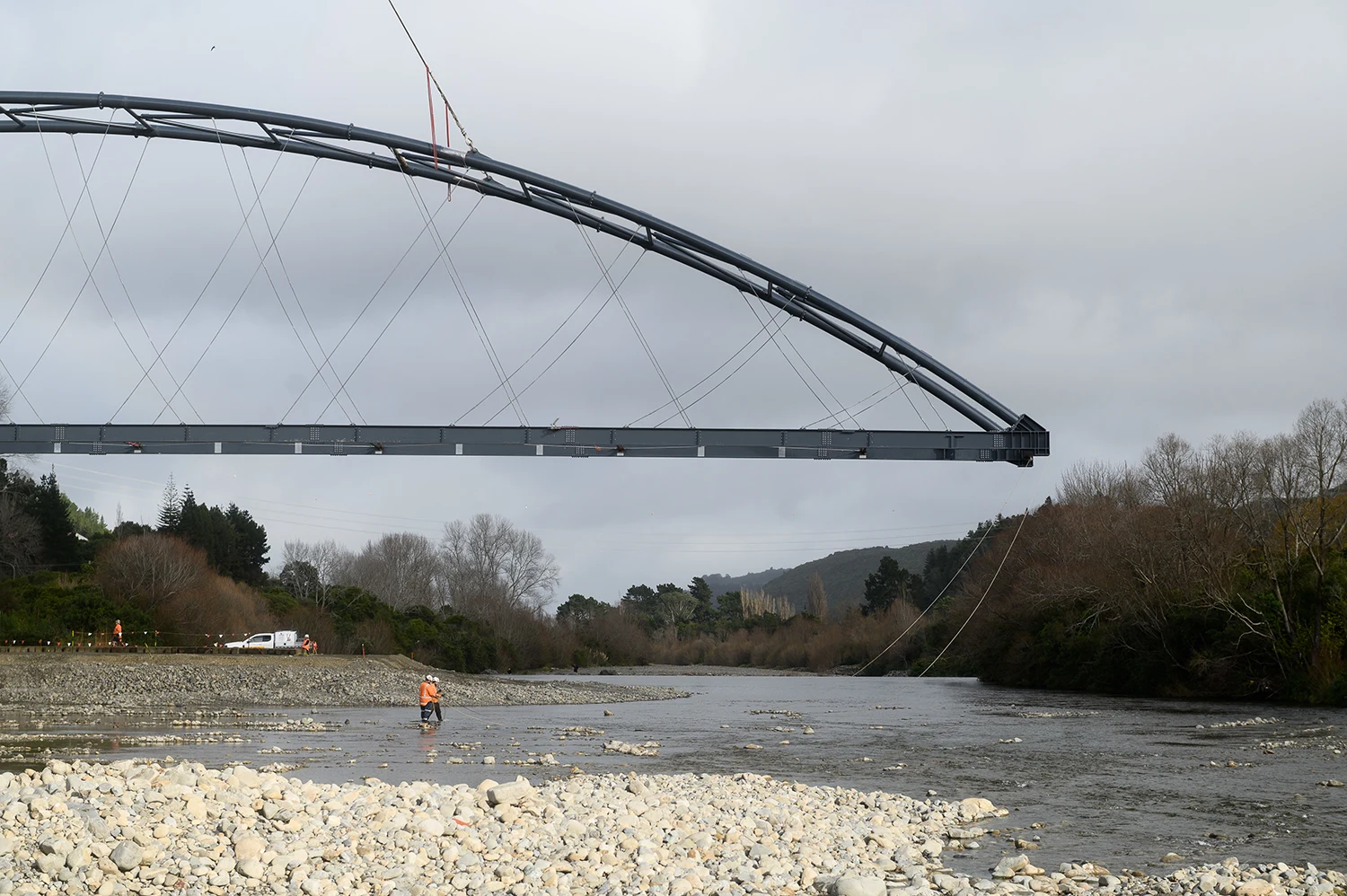
The Whakawhirinaki – Silverstream Pipe Bridge is a vital upgrade to the Wellington region’s water infrastructure that will improve water supply
Wellington Water’s Whakawhirinaki – Silverstream Pipe Bridge isn’t just a solution to ensure reliable water for Wellington’s residents; it also improves resilience from seismic and flood events, and is a key asset for maintaining operational flexibility and supply capacity for the region. It’s also a valuable community asset, which will give walkers and cyclists access across the river, and align with other environmental projects.
Set to open in 2025, the bridge and its adjoining pipeline is a step in the right direction, futureproofing Wellington’s drinking water supply for generations to come.
Project overview
The journey begins at the Kaitoke intake, where fresh water is sourced from within the stunning Tararua Regional Park, before being treated at the Te Mārua Water Treatment Plant in Upper Hutt. The safe, healthy drinking water is then sent to Upper Hutt, Stokes Valley, Manor Park, Porirua and Wellington City via a main pipeline that serves around 200,000 residents. About 60 million litres of water passes through this pipe every single day, crossing over Te Awa Kairangi/Hutt River and an active fault line.
‘It’s the number-one project in the region at the moment because the existing pipeline crossing Te Awa Kairangi/Hutt River at Silverstream is in poor condition, and is vulnerable to an earthquake and flooding events,’ says Gary Cullen, Head of Major Projects at Wellington Water.
The details
The Whakawhirinaki – Silverstream Pipe Bridge project is set to become an essential asset for the Wellington region, and is crucial for improving bulk water supply.
Wellington Water, on behalf of Greater Wellington Regional Council, is upgrading the Te Mārua to Karori pipeline, replacing the section that crosses Silverstream Road Bridge and extends along State Highway 2. The project includes installing 1.2 kilometres of one-metre-diameter underground pipe and building a new bridge to carry the pipe across Te Awa Kairangi/Hutt River. The bridge will also include a dedicated shared path for walking, cycling and recreation.
The project is divided into four stages: the Eastern Hutt Road Pipeline, the Kingsley Bulk Main Renewal, Silverstream Pipe Bridge and work within the Manor Park Golf Course. The $93-million project is part of a wider $200-million infrastructure investment program by Greater Wellington Regional Council to improve the resilience of Wellington’s water supply, which also includes the installation of a network arch bridge at Kaitoke and the Te Mārua Water Treatment Plant capacity upgrade.
Collaboration delivers better outcomes
Funded by Greater Wellington Regional Council, the main contractor is Brian Perry Civil, and the main project is designed by GHD. Other important contributions came from Boffa Miskell, which worked on landscape design; Holmes Consulting, which produced a detailed design of the bridge; E Carsons & Sons, which provided pipeline construction; and Eastbridge, for bridge construction.
Cullen describes how Wellington Water’s collaborative approach with the contractor panel delivers better results and supports the local economy.
‘We have a collaborative model in place with our contractor delivery partners. This allows us to work together to harness our joint experience and expertise as we plan the delivery of the capital investment program. Providing greater certainty of work for our delivery partners has enabled them to invest more in local people and equipment, while delivering projects efficiently.
‘As we’re regularly in contact, it also means we can reprioritise and reallocate resources as needed, as our capital program evolves. Finally, we can make sure we’re aligned on health and safety requirements.’
The impact on the community and the environment
Greater Wellington Councillor and Upper Hutt local Ros Connelly says Whakawhirinaki is a welcome addition to the river corridor and skyline. ‘The bridge will enhance connectivity for walkers and cyclists, improving access to transport and recreation options on both sides of the river.’
Cullen emphasises the valuable contribution of the community throughout the process.
‘The community provided input during the consultation period,’ he says. ‘We need access to the pipeline for maintenance to the bridge, so this was a great opportunity to provide access for the community at the same time, and a great way to link the cycleways and walking paths.’
The point where the bridge and pipeline meet is considered an eco-corridor, designed to link hills on the western and eastern sides of the Hutt Valley, supporting bird migrations between Upper Hutt, Wainuiomata, Kāpiti and Zealandia Te Māra a Tāne (Wellington’s eco-sanctuary) – something that the team has not taken lightly.
‘We had extensive engagement with Forest & Bird and GWRC during the planning phases to agree a detailed plan for planting and landscaping. Our contractor delivery partners Brian Perry Civil and E Carsons & Sons were also able to refine the approach to the pipeline construction that minimised vegetation clearance, improving environmental outcomes,’ Cullen reveals.
‘It’s an area where smaller birds can cross the valley,’ says Steven Kelliher, Project Manager for Water Services at GHD. ‘Collaboration with Forest & Bird, the Department of Conservation and the Hutt City Council reserves team ensured our approach to riparian planting and landscape design along the riverbank aligned well with local wildlife projects. Brian Perry Civil, in particular, took great care in minimising vegetation clearance, while maintaining safe access for volunteers who maintain the area and monitor a thriving lizard habitat.’
Iwi mana whenua engagement was a key aspect, with Taranaki Whānui leading a karakia and naming ceremony for the bridge in 2023.
Kura Moeahu, Chairman of Te Rūnanganui o Te Āti Awa ki te Upoko o te Ika a Māui Inc., provided insight into the name ‘Whakawhirinaki’: ‘Whirinaki is also the original name of the region, so by naming this bridge Whakawhirinaki, we are saying we have trust in it, and rely on it given the huge responsibility it has to carry our region’s water through Hutt Valley and Waiwhetū to its final destination.’
Resilience and reliability
Wellington is one of the most active seismic regions in Aotearoa New Zealand1, and the existing aging and exposed pipeline was at risk of damage due to a major earthquake or flood.
‘In Wellington, we have some pretty high seismic demands on our infrastructure, and this bridge is no different,’ says Stephen Pause, Project Director at Wellington Water. ‘The bridge is actually crossing one of the main active faults in the region, so a lot of the design for the structure was to enable a higher performance when that fault ruptures.
‘The original pipe was put on the upstream side of a road bridge when they built the network,’ Pause explains. ‘Moving the pipe to a new location on its own bridge improves access and maintainability, allowing it to cross the fault line at a more favourable location, and providing better protection from flood events.
‘The Wellington fault has a predicted movement of about five metres during a significant event, which is a lot of movement for any structure to face. So, this particular structure is lightweight, and the pipeline has fittings that allow it to accommodate significant movement,’ continues Pause.
According to Pause, when the fault line does rupture, the bridge design allows for significant flexibility and movement. But, as Pause points out, seismic technology is relatively new and developing. ‘The theory around plate tectonics didn’t exist until the early 1900s.’
Kelliher explains that the new one-metre-wide steel pipeline can be repaired easily, as it can be accessed quickly by welders and operational teams. This allows water supply to be restored quickly in the event of a major earthquake. The pipeline is also secured to the bridge, providing a resilient structure to withstand large earthquakes.
Looking ahead
In July, the bridge’s centre arch was successfully lifted into place. It was the second section of the bridge to be installed, and was positioned next to the 60-metre truss already installed on the west bank.
‘This 100-metre-long, 20-metre-tall centre arch bridge only weighs 150 tonnes,’ says Greater Wellington Corporate Services Group Manager Julie Knauf. ‘Its lightweight design has cut carbon outputs by nearly 2000 tonnes.’
A few days later, a 40-metre steel truss was installed on the east bank.
‘Stages 1, 2 and 4 are all complete; the new bridge is in place; and the pipeline on the bridge will commence installation in September,’ says Cullen. ‘The project is currently ahead of schedule and on budget. The walkways and cycleways either side of the bridge will be completed in the coming months, with commissioning of the pipeline to be completed by May 2025.’
About Wellington Water
Wellington Water is a professional water services provider, and is 100 per cent council-owned and funded by Wellington City, Hutt City, Porirua City, and Upper Hutt City councils, Greater Wellington Regional Council, and South Wairarapa District Council. These councils own the water infrastructure in the region, and task Wellington Water to manage the infrastructure and deliver water services to communities.
Images courtesy of Wellington Water.
References
1 www.learnz.org.nz/shakeout154/bg-standard-f/earthquakes-in-new-zealand